Key Takeaways
- Local businesses are losing approximately $24,000 in annual revenue due to poor digital visibility and insufficient online reviews.
- A strong Google Business Profile can increase conversion rates by 70%, turning online visibility into actual foot traffic and sales.
- Most business owners make critical mistakes by either relying solely on a website or attempting too many marketing tactics without a coherent strategy.
- The 4-part visibility framework (optimize Google Business Profile, generate reviews, sync information across platforms, and targeted advertising) creates a sustainable engine for attracting local customers.
- Weblish’s research on 1,732 local businesses reveals that simple visibility improvements can transform an overlooked business into one that consistently attracts new customers.
Think your local business is visible? Think again. According to recent research from Weblish, most local businesses are practically invisible online – and it’s costing them dearly.
The digital landscape has dramatically shifted for local businesses. While having a storefront on Main Street once guaranteed visibility, today’s customers are finding businesses through digital storefronts first. Weblish’s comprehensive Local Visibility and Trust Report revealed a startling truth: weak search engine profiles and lack of reviews are causing small businesses to lose an estimated $24,000 in revenue every single year. This isn’t just a marketing problem—it’s a survival issue for local businesses.
The visibility gap between thriving local businesses and struggling ones isn’t about luck or location anymore. It’s about mastering a specific set of digital visibility strategies that act like a 24/7 customer acquisition system. Let’s break down why this matters so much and exactly how to fix it.
The Hidden Crisis Costing Local Businesses $24,000+ Annually
The numbers are shocking but clear. Weblish’s analysis of 1,732 local businesses—including clinics, restaurants, salons, professional services, and local shops—uncovered a visibility crisis hiding in plain sight. When potential customers search for services you provide, is your business showing up? For most local businesses, the answer is a resounding no.
Consider this: a typical local business receives around 600 views per month on its Google Business Profile. With a strong, complete profile and healthy review count, conversion rates hover around 7% – turning digital visibility into actual foot traffic and sales. But businesses with weak profiles and few reviews see conversion rates plummet to just 3%. That gap—4% of 7,200 annual views—represents approximately 288 lost customers each year.
Multiply those lost customers by even a modest average purchase value of $85, and you’re looking at $24,480 in annual revenue simply disappearing because potential customers couldn’t find or trust your business online. For many businesses offering higher-value services like professional trades, clinics, or specialist services, the actual losses could be substantially higher.
Why Traditional Visibility Strategies Are Failing Modern Businesses
The problem isn’t that local business owners aren’t trying—it’s that they’re using outdated visibility playbooks in a digital world that’s rapidly evolved. Traditional marketing approaches like Yellow Pages, newspaper ads, and even basic websites alone can’t match how today’s consumers actually find and choose local businesses.
Modern consumers discover businesses differently than they did even five years ago. They search with questions rather than business names. They compare options almost instantaneously. And perhaps most importantly, they make decisions based on social proof before ever setting foot in a physical location. If your visibility strategy doesn’t account for these fundamental shifts, you’re essentially invisible to a massive portion of your potential customer base.
The Two Critical Mistakes Most Owners Make
When it comes to visibility, most business owners fall into one of two traps. The first group believes that simply having a website or Facebook page is sufficient for visibility. They built it, so customers should come, right? Unfortunately, a website without a comprehensive visibility strategy is like a billboard in the desert—impressive, perhaps, but seen by almost no one.
The second group makes the opposite mistake: they attempt to do everything at once. They create profiles on every platform, launch multiple ad campaigns, and spread themselves too thin without any cohesive strategy. The result is typically burnout, wasted resources, and minimal visibility improvement.
The solution isn’t doing more—it’s doing the right things in the right order with consistency. As Weblish’s research demonstrates, a focused visibility strategy that prioritizes the platforms where your customers actually search yields dramatically better results than scattered efforts across every available channel.
Why Having “Just a Website” Isn’t Enough Anymore
Your website remains important, but it’s no longer the starting point of the customer journey. According to Weblish’s analysis, most consumers now discover local businesses through maps and search engines first, not by directly visiting websites. This means your Google Business Profile might actually be more important than your website for generating initial visibility.
Consider how people actually find local services: “dentist near me,” “best Italian restaurant downtown,” or “emergency plumber.” These searches trigger location-based results and map listings before traditional websites. If your business isn’t properly optimized for these discovery channels, potential customers will never even see your beautifully designed website.
“Visibility is the new currency of small business success. The more people who see you, trust you, and remember you, the faster your business grows. But visibility isn’t about shouting louder—it’s about showing up smarter.”
The Real Cost of Digital Invisibility
The cost of poor visibility extends beyond just lost immediate sales. When your business remains invisible online, you’re also missing critical opportunities to build brand recognition, establish trust, and develop the kind of ongoing relationships that lead to repeat business and referrals. To understand why businesses should focus on organic reach, consider why 94% of searches click on organic results.
Every day your business operates with suboptimal visibility is a day your competitors can capture market share that should be yours. And unlike traditional marketing, digital visibility compounds over time—meaning businesses that establish strong profiles now will find it increasingly easier to maintain their advantage, while those who delay will face an increasingly uphill battle. Understanding why 94% of searches click organic results can help you strategize effectively.
The financial impact is substantial. Based on Weblish’s model of a typical local business, the difference between a weak online presence and a strong one represents about $24,000 in annual revenue—revenue that flows directly to better-positioned competitors instead of your business.
Building Your Local Visibility Engine: The 4-Part Framework
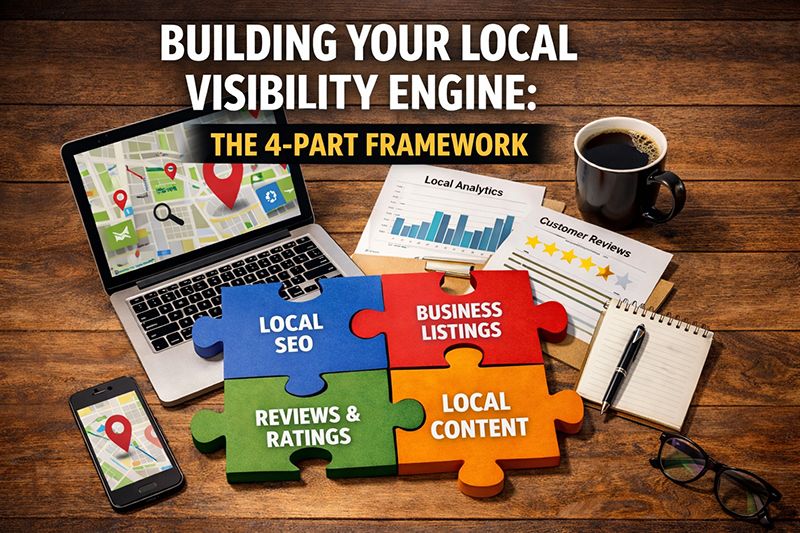
Based on the extensive research across thousands of local businesses, a clear pattern emerges for businesses that succeed in capturing local visibility. Think of this as your visibility engine—four interconnected components that work together to propel your business to the top of local searches and customer awareness.
Rather than scattered marketing efforts, this framework focuses on building a system that continuously generates visibility without requiring constant hands-on effort. Each component enhances the others, creating a self-reinforcing cycle that becomes increasingly powerful over time. For insights on why this approach outperforms traditional methods, explore authority building over vanity metrics.
Your Foundation: Claiming and Optimizing Google Business Profile
Your Google Business Profile (formerly Google My Business) is the cornerstone of local visibility. According to Weblish’s research, a fully optimized GBP can increase your chances of appearing in the coveted “Map Pack” by up to 70%. Yet astonishingly, 24% of the businesses studied had incomplete profiles missing critical elements like business hours, photos, or service areas.
Start by claiming your profile if you haven’t already, then focus on completing every possible section. Add at least 10 high-quality photos showing your business, staff, and products. Write a detailed business description that includes your primary keywords naturally. List every service you offer with descriptions. And most importantly, verify your business to unlock the full power of Google’s local search algorithm.
This takes less than 15 minutes to set up but makes a massive difference in how often your business appears in local search results. It’s the single highest-leverage activity for most local businesses looking to improve visibility.
Your Trust Signal: Implementing a Simple Review Generation System
Reviews aren’t just nice to have—they’re essential trust signals that directly influence both visibility and conversion rates. Weblish’s analysis found businesses with fewer than 10 reviews had average conversion rates of just 2.8%, while those with 50+ reviews saw rates jump to 7.3%. That difference alone represents more than $20,000 in annual revenue for a typical local business.
Creating a systematic approach to generating reviews is critical. This doesn’t mean fake reviews or pressuring customers, but rather implementing touchpoints that naturally encourage satisfied customers to share their experiences. The simplest system involves sending a follow-up message after service completion with a direct link to leave a review. More sophisticated approaches might include review generation tools that streamline the process.
Remember that consistency matters more than volume. Five reviews per month will build a powerful review profile faster than 20 reviews in one month and none for the next five months. Your goal should be establishing a steady rhythm of authentic customer feedback.
Your Consistency Network: Keeping Information Synced Across Platforms
Inconsistent business information across the web undermines trust and visibility. When your address is different on Yelp than it is on Google, or your hours vary between Facebook and your website, both customers and search algorithms lose confidence in your business. Weblish’s research found 31% of local businesses had significant information discrepancies across platforms.
Start by creating a master information document containing your canonical business name, address, phone number, website URL, hours, and business description. Then methodically update every platform where your business appears to match this information exactly. Pay particular attention to citation sites like Yelp, Yellow Pages, BBB, industry directories, and social media platforms.
For ongoing management, consider using a citation management tool or service that can monitor and maintain consistency across dozens of platforms automatically. This “set and forget” approach ensures your business information remains accurate everywhere, even as details change over time.
Your Expansion Strategy: Smart, Targeted Advertising That Actually Works
While organic visibility builds trust, paid visibility helps you grow that trust faster and reach people who don’t know you yet. The key difference between businesses that waste money on advertising and those that see strong ROI is targeting precision. Generic “boost this post” approaches rarely deliver meaningful results, as highlighted in this cost comparison guide.
Start with a small, highly targeted campaign focused on people within your service area who have demonstrated specific behaviors related to your offerings. For example, a local salon might target women within 5 miles who have recently searched for hair styling services or engaged with beauty content. This precision targeting typically costs more per impression but delivers dramatically higher conversion rates, especially when combined with strategies like authority building.
Modern advertising platforms allow for remarketing to people who have visited your website or engaged with your social content, creating multiple touchpoints that build familiarity and trust. When combined with strong organic visibility, these paid strategies create a powerful multiplier effect that accelerates growth.
The 7-Day Local Visibility Makeover
Transforming your local visibility doesn’t have to be overwhelming. This seven-day plan breaks the process into manageable daily actions that systematically build your visibility engine piece by piece. By day seven, you’ll have established the core systems that will continue working for you with minimal maintenance.
Day 1-2: Complete Your Digital Storefront
Begin with claiming and fully optimizing your Google Business Profile. Add high-quality photos showing your business interior, exterior, team members, and products or services. Write a keyword-rich but natural description of your business, ensuring you’ve completed every available field. Verify your listing if you haven’t already, and double-check that your NAP (Name, Address, Phone) information matches your website exactly.
Next, conduct a quick audit of your website’s local SEO fundamentals. Add your full business address in the footer. Create or update your contact page with embedded Google Maps. Ensure your business name, address, and phone number appear consistently throughout the site. Add geographic terms to your page titles and H1 headings where natural (e.g., “Premium Haircuts in [City Name]” rather than just “Premium Haircuts”). For more insights on organic traffic, explore our traffic allocation guide.
Finally, create or claim your profile on the primary review platforms for your industry. For most businesses, this includes Yelp and Facebook, plus industry-specific sites like TripAdvisor (hospitality), Healthgrades (medical), or Houzz (home services).
Day 3-4: Set Up Your Automated Review Machine
Building a consistent flow of authentic reviews requires a system, not sporadic requests. Start by creating a simple template for requesting reviews that you can personalize for each customer. The most effective requests are brief, specific about what service was provided, and include a direct link to your Google review page.
Next, determine your review collection trigger points—the specific moments in your customer journey when you’ll request feedback. For service businesses, this is typically 1-3 days after service completion. For retail, it might be after the customer has had time to use the product. For restaurants, it could be the same evening after dining. To enhance your online visibility, consider strategies to get seen by potential customers.
Finally, automate the process. This could be as simple as creating calendar reminders to send review requests, or as sophisticated as implementing email automation software that sends personalized review requests on a schedule. Many CRMs and point-of-sale systems now include built-in review request functionality you can activate.
Day 5-6: Fix Inconsistent Business Information
Inconsistent business information across the web is a trust killer both for potential customers and search algorithms. Create a master document with your canonical business information—exact business name, address, phone, hours, website URL, and business description. This becomes your single source of truth for all platforms.
Next, conduct a citation audit using a tool like Moz Local or BrightLocal to identify where your business appears online with incorrect information. Prioritize fixing the most important directories first: Google, Yelp, Facebook, Apple Maps, Bing Places, and industry-specific platforms relevant to your business.
For ongoing maintenance, consider investing in a citation management tool that monitors and automatically corrects inconsistencies across the web. This typically costs $15-30 monthly but saves countless hours and prevents visibility-damaging discrepancies from creeping back in.
Day 7: Launch Your First Targeted Ad Campaign
With your foundation established, it’s time to accelerate visibility with a highly targeted paid campaign. Start small—even $10-20 daily can deliver significant results if properly focused. Choose the platform where your ideal customers spend the most time, typically Google Ads for service businesses or Facebook/Instagram for visually-oriented brands.
The key to effective local advertising is precision targeting. For Google, focus on zip codes or radius targeting within your service area, using keywords that include your location (e.g., “dentist in [city name]”). For social platforms, layer geographic targeting with interest-based targeting that matches your ideal customer profile.
Set up proper conversion tracking from day one, whether that’s phone calls, form submissions, or direct purchases. This allows you to measure actual return on ad spend rather than vanity metrics like impressions or clicks.
Turn Your Customers Into Your Marketing Team
The most powerful visibility boost doesn’t come from what you say about your business—it comes from what your customers say. According to Weblish’s research, businesses with robust review profiles see a 170% higher conversion rate compared to those with few or poor reviews. Here’s how to transform satisfied customers into a visibility-generating marketing force.
Why Reviews Are Your Most Powerful Visibility Tool
Reviews influence visibility in three critical ways. First, they directly impact your ranking in local search results—Google explicitly states that review quantity, quality, and recency affect positioning. Second, they dramatically increase click-through rates when your business appears in results. And third, they significantly boost conversion rates once potential customers evaluate your business. For businesses looking to enhance their online presence, understanding the balance between organic traffic vs paid ads can be crucial.
The compounding effect is substantial. A business that ranks higher gets more visibility, which leads to more customers, which leads to more reviews, which further improves ranking. This positive feedback loop is why businesses that focus on systematic review generation often dominate their local markets within 6-12 months.
Additionally, reviews provide invaluable keyword content that helps your business appear for specific search terms you might not have targeted. When customers mention specific services or products in their reviews, Google indexes this content and may display your business for related searches. For a deeper understanding of how organic search impacts visibility, explore why 94% of searches click organic results.
Creating a Frictionless Review Collection Process
The secret to generating a steady stream of reviews is removing friction from the process. Most satisfied customers are willing to leave reviews but abandon the process when it becomes complicated or time-consuming. Your goal should be making review submission possible in under 60 seconds.
Start by creating a simple shortlink to your Google review form (you can use bit.ly or a similar service). This link should take customers directly to the review form, not just to your Google Business Profile. Include this link in post-purchase emails, text messages, receipts, and even physical cards or materials provided to customers. For more insights on enhancing your online visibility, check out this guide on how to get seen.
For businesses with a physical location, consider setting up a review station with a tablet or QR code that takes customers directly to your review form. The best time to request a review is immediately after a positive experience, when satisfaction is highest.
- Ask for reviews at the right moment—after a successful service or positive comment
- Make the process one-click simple with direct links
- Follow up once (but only once) with customers who don’t initially respond
- Thank reviewers personally to encourage continued engagement
- Focus quality over quantity—authentic, detailed reviews carry more weight
3 Ways to Turn Positive Reviews Into Marketing Assets
Reviews shouldn’t just sit on Google—they should become active components of your visibility strategy. First, identify your most compelling reviews and feature them prominently on your website, particularly on landing pages targeting specific services. Include the reviewer’s name and date to enhance credibility. For more insights, consider exploring how eCommerce brands use marketing automation to boost organic traffic and visibility.
Second, repurpose reviews as social media content. Create simple graphic templates that allow you to quickly transform written reviews into shareable images. These perform exceptionally well on platforms like Facebook and Instagram, and they provide a constant stream of credible content without requiring original creation. For more insights on visibility, check out this guide on how to get seen.
Third, incorporate review snippets into your Google and Facebook ad campaigns. Ads that include social proof consistently outperform those focused solely on offerings or promotions. Many ad platforms now offer specific formats designed to showcase customer testimonials.
The Right Way to Handle Negative Reviews (And Turn Them Around)
Negative reviews aren’t visibility killers—handling them poorly is. Research shows that businesses that respond thoughtfully to negative reviews actually gain trust compared to those with only positive reviews. The key is responding promptly, professionally, and constructively.
When you receive a negative review, respond publicly within 24 hours with a non-defensive acknowledgment of the customer’s experience. Offer to make things right, and provide a direct contact method for further discussion. Then take the conversation private to resolve the specific issue. Once resolved, it’s perfectly acceptable to politely ask if the customer would consider updating their review to reflect the resolution. For more insights on boosting your brand’s credibility, consider authority building over vanity metrics.
Remember that potential customers don’t expect perfection—they expect accountability. A well-handled negative review demonstrates your commitment to customer satisfaction more effectively than a dozen generic five-star reviews.
Platform-Specific Visibility Tactics That Actually Work
Different visibility platforms require different approaches. Rather than spreading yourself thin across every possible channel, focus on mastering the platforms most relevant to your specific business type and customer base. Here are proven tactics for the three most impactful local visibility channels.
Google: Beyond the Basics for Maximum Map Pack Dominance
To maximize Google visibility beyond the basic profile optimization, focus on these high-impact activities. First, post regularly on your Google Business Profile using the Updates feature. These posts appear directly in your listing and signal to Google that your business is active and engaged. Aim for weekly posts that include specials, events, or helpful information.
Second, add new photos to your profile weekly. Google’s algorithms heavily favor businesses with fresh, quality visual content. Businesses in the top 20% for photo quantity and quality see 35% more clicks to their website compared to the average business profile.
Third, answer questions in the Q&A section proactively. Don’t wait for customers to ask—create a FAQ section by posting common questions and answering them yourself. This improves user experience and provides additional keyword-rich content that enhances visibility.
Facebook: Creating Content That Triggers the Algorithm
Facebook visibility hinges on creating content that generates meaningful interactions. Comments and shares carry significantly more weight than likes in the current algorithm. The most effective approach is posting content that explicitly invites response through questions, polls, or requests for specific feedback.
Video content receives 59% more engagement than any other content type on Facebook, according to Weblish’s analysis. Even simple videos shot on a smartphone can dramatically increase your visibility if they provide authentic, valuable glimpses into your business operations, team, or expertise.
For local businesses, content that celebrates or highlights your community performs exceptionally well. Showcase local events, partner with complementary local businesses for cross-promotion, or spotlight customers (with permission) to create content that resonates with your geographic audience. Consider leveraging content repurposing strategies to maximize the reach and impact of your local-focused content.
Instagram: Visual Storytelling for Local Visibility
Instagram success for local businesses comes from strategic use of location features. Always tag your physical location in posts and stories, and use location-based hashtags that include your neighborhood, city, and region. This makes your content discoverable to people browsing local content, even if they don’t yet follow your account. Understanding the traffic allocation can further enhance your strategy by targeting the right audience effectively.
Use Instagram Stories to provide behind-the-scenes glimpses of your business operations, highlight team members, or showcase customer experiences. These authentic, ephemeral moments build connection and trust, particularly with younger demographics who rely heavily on Instagram for local business discovery.
Instagram Reels have become the platform’s most visible content format, with the algorithm heavily favoring these short videos in discovery. Creating simple 15-30 second demonstrations, tips, or highlights related to your business can rapidly expand your visibility to new local audiences.
How AI Tools Are Revolutionizing Local Business Visibility
The visibility game has fundamentally changed with the emergence of accessible AI tools designed specifically for local businesses. These tools are leveling the playing field, allowing small operations to execute sophisticated visibility strategies previously available only to businesses with dedicated marketing teams or agencies. For those interested in understanding the benefits of organic traffic over paid ads, this cost comparison guide offers valuable insights.
Automating Your Review Collection Process
AI-powered review management tools have evolved beyond simple email automation. Modern systems can identify the optimal timing for review requests based on customer interaction patterns, personalize messages based on purchase history, and even predict which customers are most likely to leave positive reviews. These systems typically integrate directly with your POS or CRM system, creating a fully automated review generation pipeline.
Tools like Podium, BirdEye, and Weblish’s review automation platform can increase review conversion rates by 300-400% compared to manual processes. The most sophisticated systems can even detect sentiment in customer communications and only trigger review requests after positive interactions, minimizing the risk of negative reviews.
Smart Ad Targeting Without the Learning Curve
AI-driven advertising platforms have dramatically reduced the expertise required to run effective local campaigns. Rather than manually selecting targeting parameters, these systems analyze your customer data and website visitors to build precise audience models. They continuously optimize based on conversion data, automatically shifting budget toward the targeting combinations that deliver actual business results. For more insights, check out this article on how to get seen in the digital space.
Content Creation Tools That Save Hours Each Week
Creating fresh, engaging content across multiple platforms is one of the biggest visibility challenges for time-strapped business owners. AI content assistants now offer the ability to generate location-specific content ideas, draft social media posts, and even create basic graphics that maintain brand consistency without requiring design skills.
Measuring What Matters: Visibility Metrics That Predict Growth
Without measuring the right metrics, visibility efforts quickly become directionless. Most business owners track too many vanity metrics that look impressive but don’t correlate with actual business growth. The key is focusing on a small set of high-value indicators that truly predict revenue impact.
Visibility isn’t valuable unless it converts to customer action. The most sophisticated local businesses have moved beyond tracking impressions or rankings to building comprehensive visibility-to-revenue pipelines that show exactly how online presence translates to business results.
The 5 Numbers That Actually Tell You If You’re Visible
Focus on tracking these five core metrics that genuinely reflect your local visibility health. First, track Google Business Profile views, which indicate how many potential customers are finding your business through local search. Second, monitor click-to-call and direction requests from your Google profile—these represent high-intent actions from potential customers.
Third, measure review velocity (the rate at which you’re acquiring new reviews) rather than just total review count. Fourth, track branded search volume—how many people are searching specifically for your business name. This indicates growing brand awareness in your local market. Fifth, monitor referral traffic from directories and maps to your website, which shows how effectively your visibility is driving deeper engagement.
Simple Dashboards to Track Your Visibility Progress
Creating a simple visibility dashboard prevents the common problem of data overwhelm. Google Data Studio (now called Looker Studio) offers free dashboards that can integrate data from Google Business Profile, Google Analytics, and even social platforms. For non-technical owners, simpler tools like DashThis or Databox provide template dashboards specifically designed for local business visibility tracking.
The ideal dashboard should display your five core metrics prominently, with the ability to view trends over time rather than just current numbers. Set monthly visibility goals for each metric and track progress weekly to maintain focus and accountability.
Many successful local businesses have adopted a “visibility scorecard” approach, assigning point values to different visibility metrics and tracking an overall visibility score. This simplifies monitoring and creates a gamified system where teams can celebrate improvements in overall visibility health.
When to Adjust Your Strategy Based on the Data
Data should trigger specific actions, not just provide information. Establish clear thresholds for when metrics should prompt strategy adjustments. For example, if your Google Business Profile views drop by more than 15% for two consecutive weeks, it might indicate a potential penalty or algorithm change requiring immediate attention.
Your 90-Day Visibility Acceleration Plan
Creating sustainable visibility requires a structured approach that builds momentum over time. This 90-day roadmap provides a clear sequence of activities designed to systematically enhance your visibility across all key platforms while establishing the systems that ensure continued visibility growth.
The plan works by focusing on one primary visibility channel each month, mastering it before expanding efforts to additional platforms. This focused approach prevents the common mistake of diluting efforts across too many channels simultaneously, which typically results in poor performance across all of them. For businesses considering whether to use an all-in-one platform vs. multiple tools, this strategy can help streamline efforts and improve efficiency.
Frequently Asked Questions
As local business visibility has evolved, so have the questions business owners ask about effectively managing their online presence. Here are evidence-based answers to the most common visibility questions based on Weblish’s research across thousands of local businesses.
How long does it take to see results from improving local business visibility?
Initial visibility improvements typically appear within 2-4 weeks of implementing foundation-level changes like completing your Google Business Profile and fixing inconsistent business information. However, the full impact of a comprehensive visibility strategy generally takes 3-6 months to materialize.
The timeline varies based on three key factors: your starting point (businesses with very poor visibility often see faster initial gains), your market competitiveness (highly saturated markets take longer to penetrate), and your consistency in implementing visibility-enhancing activities.
Most businesses observe a “visibility tipping point” around the 90-day mark, where compounding effects begin to accelerate results. This often coincides with achieving 40+ reviews and establishing consistent content publishing across your primary platforms. For more insights on how to get seen in the digital landscape, explore available resources.
- 2-4 weeks: Initial improvements in search appearance and basic visibility
- 1-2 months: Noticeable increase in profile views and customer actions
- 3-4 months: Significant improvement in rankings and customer engagement
- 6+ months: Established visibility dominance for your primary keywords
- Ongoing: Maintenance and expansion of visibility advantages
Do I need to be on every social media platform to improve visibility?
Absolutely not. In fact, Weblish’s research shows that businesses attempting to maintain presence on more than three social platforms typically perform worse on all of them compared to businesses that focus on mastering 1-2 platforms. The key is identifying where your specific customer demographic is most active and concentrating your efforts there rather than diluting your presence across every available platform.
What’s the minimum budget needed for effective local advertising?
Effective local advertising can begin with as little as $300-500 monthly if properly targeted. The minimum viable budget depends primarily on your competitive landscape and average customer value. Businesses with high-value customers (like legal services, medical practices, or home services) typically need higher budgets due to more expensive keywords and competitive bidding.
Rather than thinking about minimum budgets, focus on customer acquisition cost. Track how much you’re spending per lead or new customer generated, then compare this to the customer lifetime value. As long as your acquisition cost remains significantly below customer value, the advertising is sustainable regardless of total budget. For insights on optimizing costs, consider how hidden time costs can impact your overall strategy.
How many reviews do I need before they start impacting my visibility?
Reviews begin influencing your visibility with the very first one, but significant impact typically starts at around 10 reviews. The first threshold where substantial visibility benefits appear is 39 reviews—at this point, Google’s algorithms consistently show increased confidence in your business relevance and credibility.
Can I improve my local visibility without hiring an agency?
Yes, most local businesses can significantly improve their visibility without agency support if they’re willing to commit 2-3 hours weekly to focused visibility activities. The key is prioritization—focusing on the highest-leverage activities first and implementing systems that automate repetitive tasks.
“Local visibility is not a complex equation. A few disciplined steps can turn a weak, overlooked profile into one that reliably brings new customers through the door.” — Weblish Local Visibility Report
The visibility landscape for local businesses has fundamentally changed, but the principles of success remain refreshingly straightforward. Businesses that establish strong foundations, implement systematic review generation, maintain information consistency, and deploy targeted advertising consistently outperform competitors regardless of marketing budgets or resources.
The difference between visible local businesses and invisible ones isn’t luck or location—it’s the disciplined application of proven visibility strategies that align with how modern consumers actually find and choose local providers. By implementing the framework outlined in this guide, any local business can transform its visibility from a weakness to a powerful competitive advantage.
Most importantly, remember that visibility isn’t a one-time project but an ongoing system that requires maintenance and refinement. The businesses that maintain visibility leadership are those that establish sustainable processes rather than pursuing scattered tactics. With the right approach, your business can build a visibility engine that delivers new customers consistently for years to come.
Your visibility journey starts with your foundation: a solid website, an optimized Google profile, and one social platform where your business shows up consistently. From there, systematic expansion based on data-driven decisions will create the kind of visibility that transforms occasional customers into consistent revenue. https://www.ethosm2.com/dm <—– Get Started today!