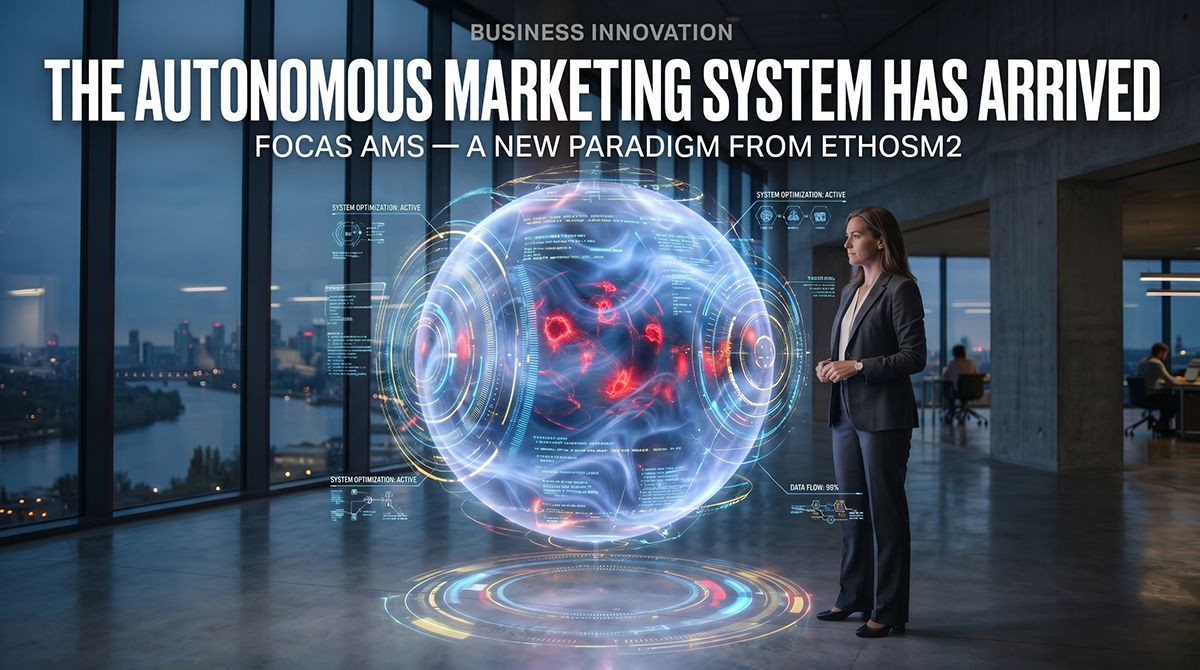
- An autonomous marketing system is not a chatbot or a dashboard — it is a system that can understand market signals, make decisions, and run campaigns without requiring you to manage every step.
- Most small businesses are running 2026 revenue goals on 2019 marketing infrastructure, and the gap is widening every quarter AI-driven search reshapes who gets found online.
- FOCAS AMS™ is the only done-for-you autonomous marketing system built inside a structured methodology — the FOCAS Framework™ — anchored to your specific revenue target, not a generic feature set.
- The average enterprise deploying agentic AI systems reports a 171% ROI, yet fewer than 7% of small businesses have access to comparable infrastructure — that gap is what EthosM2 was built to close.
- By the end of this article, you will understand exactly what separates an autonomous marketing system from marketing software, why the timing matters, and how the FOCAS Framework™ stages work together to produce compounding growth.
The Question Most Marketing Software Cannot Answer
Ask any small business owner what they actually want from marketing and the answer is almost always the same: more clients, more revenue, more predictability. Ask most marketing platforms that same question and what you get back is a feature list — automation workflows, email sequences, social scheduling, landing page builders. Features are not answers. They are tasks dressed up as solutions.
The ultimate question that reveals if a marketing system is designed for your business or for a sales deck is straightforward: How much revenue are you targeting, and what do you need to do to achieve it? Most platforms are not capable of answering that. They provide you with the tools and leave you to devise the strategy, carry out the execution, determine the sequencing, and optimize it by yourself.
- You are the one who establishes the workflows
- You are the one who writes the copy
- You are the one who oversees the campaigns
- You are the one who makes sense of the data
- You are the one who tweaks the strategy
- You are the one who repeats the process every month
This is not a marketing system. This is an additional job that comes with a monthly subscription fee.
Why the question “How Much Revenue Do You Want?” highlights a flawed system
“A tool that necessitates you to do all the strategizing, all the implementation, and all the enhancement is not a system. It is a collection of components. And components do not expand your business — structure does.”
— J. Marcus Howard, President and CEO, Ethos Media Marketing and Consulting LLC
When EthosM2 began creating the FOCAS Framework™, the initial question was not “what tools do small businesses need?” Instead, it was “what does a business need to consistently achieve a specific revenue outcome?” These are fundamentally different questions that lead to fundamentally different systems. One results in a feature catalog. The other results in a structured methodology with built-in execution.
Asking about revenue brings focus. It sets a timeline. It necessitates that every marketing action — content, SEO, paid media, reputation, automation — be tied to a result rather than just being implemented and hoping for the best. That tying is what most marketing software completely overlooks, because it requires understanding your business, not just your billing cycle.
The Execution Gap: The Graveyard of Marketing Goals
Small business owners often have lofty marketing goals that never come to fruition. The desire is there — they want to create better content, reach out to customers more consistently, improve local SEO, and develop a functioning email sequence. The problem isn’t a lack of desire. The problem is a lack of execution capacity.
Small business owners are usually operators first and foremost. They run the business, manage the team, deal with client delivery, and somehow find time to consistently create content, strategize paid media, manage their reputation, and be the voice of their brand. This is not a sustainable model. The businesses that realize this first are the ones that stop trying to do everything manually and start creating systems that can run without them.
Research from Salesforce shows that top-performing marketing teams are 2.5x more likely to make AI and automation a key part of their strategy compared to those that underperform. The difference between these groups is not usually budget. It’s infrastructure.
The Necessary Components for a True Answer
A real answer to the question of revenue requires four components working in tandem: a clear strategy tied to your market position, consistent execution across multiple channels that doesn’t rely on you being available, real-time signal processing that adjusts based on what’s working, and visibility that compounds over time instead of peaking and then disappearing.
An autonomous marketing system is designed to deliver a combination of strategy, execution, optimization, and compounding growth. It’s not a promise, it’s an architecture. The FOCAS Framework™ was specifically designed to make this architecture accessible to businesses that have never had the luxury of a 20-person marketing department to build it for them.
Transitioning from AI-Assisted to Fully Autonomous Marketing Systems
For the past three years, the marketing technology sector has been abuzz with talk of AI as a helpful assistant — a tool that can provide support, make suggestions, and expedite tasks that humans are still largely accountable for. This approach has its merits. However, it still necessitates a human operator. And most small business owners simply do not have the time to serve as the operator.
Right now, we’re seeing a shift. It’s happening in enterprise, mid-market, and even small business. It’s the shift from AI as an assistant to AI as an operator. We’re moving towards systems that don’t just help you make decisions, but that are built to make and execute decisions within certain parameters. They learn from outcomes and adjust without needing a human to step in at every stage. This is the agentic AI model, and it’s redefining what marketing infrastructure looks like for all types of businesses.
What Agentic AI Actually Means — Without the Tech Speak
Agentic AI means a system that can perceive conditions, decide on a course of action, execute that action, and learn from the result — without a human approving each step. Think of it less like a smart tool and more like a trained operator who works around the clock, processes more data than any human team could review, and gets better at the job every week. That is the functional model behind FOCAS AMS™, built by EthosM2 as the execution engine inside the FOCAS Framework™.
Enterprise vs. Small Business: Why 34% of Big Businesses Use Autonomous Systems, and Only 7% of Small Businesses Do
McKinsey’s 2024 State of AI report reveals that around 34% of enterprise organizations have already incorporated autonomous AI systems into their core business operations. On the other hand, the adoption rate among small businesses is around 7%. This is not a minor difference – it’s a structural advantage that grows with each quarter the gap remains. Enterprises are using autonomous systems to work faster, spend more efficiently, and dominate search visibility, while most small businesses are still manually scheduling posts and wondering why their reach continues to decline.
The Authority Gap: The Consequences of Businesses Falling Behind
There is a point where inconsistent marketing becomes more than just an inconvenience, it becomes a structural limit on growth. EthosM2 refers to this as the Authority Gap — the invisible cap on revenue, reach, and market position that forms when a business is unable to sustain the volume, consistency, and quality of market presence required to compete at the next level. The businesses that hit this gap are not failing because of poor products or subpar service. They are failing because their marketing infrastructure is unable to keep up with their ambitions.
Why Most Autonomous Marketing Platforms Weren’t Designed With You in Mind
Marketing automation is a $6.4 billion industry, as reported by Grand View Research. The lion’s share of this revenue is generated by platforms designed for enterprise-level customers. These are organizations that have dedicated marketing operations teams, technology budgets in the six figures, and the internal resources necessary to set up, manage, and refine complex systems. The versions of these platforms designed for small businesses usually offer a limited feature set and less support, but still require the same level of operational overhead to run effectively.
Enterprise Tools with Small Business Pricing
Just because an enterprise tool is affordable, it doesn’t necessarily mean it’s suitable for a small business. What makes a tool suitable for a small business is its ability to produce results without needing a lot of internal resources to run it. Many of the platforms available today don’t meet this requirement. They offer lower starting levels but keep the complexity, expecting business owners to create their own automations, write their own sequences, understand their own analytics, and make their own strategic decisions in whatever time they have left after running their business.
How Tool Sprawl and Integration Taxes Are Draining Small Business Budgets
Did you know that the typical small business using digital marketing tools is shelling out money for six to twelve different platforms? Each one requires its own login, has its own learning curve, its own support queue, and its own monthly fee. There’s a CRM here, an email platform there, a social scheduler over there, an SEO tool, a review management tool, a paid media dashboard, an analytics layer. None of them communicate with each other effectively. All of them need someone to manage them. More often than not, that someone is the business owner.
EthosM2 refers to this as the integration tax. It’s the concealed expense in time, money, and strategy that piles up when a company attempts to piece together a marketing operation from separate parts. It’s more than just a budget issue. It’s a structural issue. And no amount of optimizing individual tools can repair a broken structure. To address these challenges, understanding how AI support intelligence can solve technology implementation failures is crucial.
Small Businesses Need a System, Not Another Dashboard
- A single, strategic framework that connects every marketing activity to a revenue outcome
- Execution that runs without requiring the owner to be the operator
- Consistent multi-channel presence that compounds over time rather than spiking and fading
- Intelligent optimization that adjusts based on real performance data, not gut instinct
- Transparent reporting that shows revenue progress, not just vanity metrics
That list describes a system. Not a tool, not a dashboard, not a platform with a lower price tier. A system has a methodology underneath it. It has sequencing. It has defined outcomes at each stage. It knows what it is trying to accomplish and it moves toward that target with or without constant human input.
The difference is important because most small business owners have already tried the individual tool approach. They’ve paid for the CRM that they never fully set up. They’ve purchased the SEO plugin that produced reports that no one had time to implement. They’ve subscribed to the social scheduler that went unused after the first two weeks because content creation was no longer a priority. Tools without systems generate activity. Systems generate results.
When a business ceases to purchase tools and begins to implement a system, the correlation between effort and output is altered. Effort is no longer the main input. The system takes on the task of execution, allowing the owner to concentrate on decisions that truly require their judgment — product, client relationships, team, vision. This shift is not minor. It is a fundamental change.
Most small businesses have been unable to make this structural shift, not due to a lack of sophistication, but due to a lack of access. The systems that could deliver this were priced for enterprise buyers and configured for enterprise teams. This is the gap that EthosM2 was designed to fill, and FOCAS AMS™ is the tool designed to fill it. For those interested in how AI support intelligence can aid small business technology implementation, check out this article.
Meet FOCAS AMS™
We would like to introduce FOCAS AMS™, the Autonomous Marketing System. This is a marketing system that we build for you, using the FOCAS Framework™. It’s designed to provide high-quality marketing to small and mid-sized businesses, without the need for a large budget or a large team. This isn’t a software that you have to license and configure yourself. Instead, this is a system that we build for your business, around your revenue target. And then we operate it for you.
How AMS Functions Within the FOCAS Framework™
The FOCAS Framework™ is a five-part growth strategy — Foundation, Operations, Conversion, Amplification, Scale — and AMS is the executing force that spans all five parts. Each part of the framework has specified inputs, specified outputs, and a unique role in propelling a business from its existing market position to its revenue goal. AMS is not a feature that sits atop this framework. Instead, it is ingrained within it as the operative method.
It’s important to understand where AMS fits into the framework, because it helps clarify why the system yields different results than a standalone marketing tool. A tool operates on its own. AMS, on the other hand, operates within a sequence, with each stage building on the previous one and each output becoming the input for the next phase of growth. This sequencing is what produces compounding results rather than one-off campaigns.
Here’s how the autonomous marketing system breaks down:
FOCAS Stage
What Gets Built
AMS Role
Foundation
Brand positioning, digital infrastructure, market clarity
Establishes the strategic base all autonomous activity runs on
Operations
Workflow automation, CRM integration, process systems
Connects marketing execution to business operations seamlessly
Conversion
Lead capture, nurture sequences, offer optimization
Runs autonomous follow-up and conversion pathways without manual input
Amplification
Content engine, paid media, reputation, omnichannel presence
Executes consistent multi-channel output at volume and velocity
Scale
Market expansion, revenue compounding, authority dominance
Optimizes and reinvests performance data to accelerate growth trajectory
Every activity inside FOCAS AMS™ maps to one of these five stages. Nothing runs without purpose. Nothing is deployed without a defined outcome it is moving toward. That is what separates a methodology-anchored system from a platform that offers automation as a feature.
Multiple Agents Working Together, Based on Methodology, Not Features
FOCAS AMS™ is powered on a technical level by a group of autonomous agents working together—each one responsible for a specific function within the marketing system—working together instead of separately. One agent monitors search visibility and adjusts content strategy. Another manages reputation signals and triggers response workflows. Another tracks lead behavior and moves prospects through conversion sequences based on real-time engagement data. These agents do not operate independently. They are orchestrated—meaning their outputs inform each other, their decisions are coordinated, and the system as a whole moves toward the revenue target rather than each component optimizing for its own narrow metric. This is the architecture that makes FOCAS AMS™ function as a system rather than a collection of automated tasks.
Five Key Features of FOCAS AMS™
FOCAS AMS™ has five key features that work together as a single integrated system. The autonomous content production feature ensures your brand is visible across search, social, and local channels without you having to write, edit, or schedule anything. The intelligent lead management feature captures, qualifies, and nurtures prospects through personalized sequences that adjust based on behavior. The reputation and authority building feature monitors your market presence and actively grows your review profile and local credibility. The paid media optimization feature deploys and adjusts ad spend based on performance signals, not monthly manual reviews. The performance intelligence feature gives you a clear, plain-English view of what is working, what has changed, and what the system is doing about it — so you are always informed without being required to manage the machine.
Designed for Businesses That Can’t Afford a 20-Person Marketing Team
When we say a 20-person marketing team, we aren’t just throwing numbers out there. This is the actual size of the teams that large companies use to manage the amount and variety of marketing activity that FOCAS AMS™ can handle on its own. Content strategists, SEO specialists, paid media buyers, email marketers, social media managers, reputation coordinators, analytics interpreters, CRM administrators — these large companies have entire departments to handle what AMS can do in one system. Now, the small business that couldn’t afford such a team has access to the same capabilities, through a system designed specifically for their growth stage and revenue goals.
Implications for Small Business Owners
The benefits of implementing an autonomous marketing system are concrete and show up in three key areas that build upon each other over time: time saved from manual marketing tasks, increased revenue from a consistent and optimized market presence, and a change in competitive position that most small businesses have not previously had access to.
Freeing Up Your Time: The Actual Benefits of Autonomous Execution
According to a survey by Constant Contact, small business owners who handle their own marketing spend an average of 20 hours a week on marketing-related tasks. That’s half a full-time work week that could be spent on other tasks, which FOCAS AMS™ can handle autonomously. When you get that time back, it doesn’t just disappear – it gets redirected to tasks that only the owner can handle: strategic relationships, product refinement, team leadership, and the high-judgment decisions that actually move the business forward. The compounding effect of that reallocation over 12 months is significant in ways that go beyond what any single campaign could produce.
The Power of Consistency: Building Authority Over Time Through Omnichannel Presence
Consistency in marketing is an often-overlooked dynamic in small business marketing. A business that consistently appears across search, social, local directories, and review platforms every week, with relevant content, optimized positioning, and responsive reputation management, builds an authority that a sporadic campaign cannot match. Google rewards consistency. Prospects trust brands they see repeatedly across multiple channels. Referral networks amplify businesses that maintain a visible, professional market presence. All of these factors compound over time.
FOCAS AMS™ is designed to consistently deliver high-quality content at a rate that no small business owner could maintain on their own. The system never takes a week off. It doesn’t stop producing content when things get hectic. It doesn’t halt paid media because no one had time to check the dashboard. It’s always on, always learning, and always improving — which means that the marketing work done in the third month builds on the authority established in the first month, and the sixth month builds on everything that came before.
Equalizing Business Infrastructure: Enterprise-Level Marketing Without the Enterprise Costs
The term “leveling the playing field” is often thrown around in marketing, but in this case, it has a very specific structural meaning. For over a decade, enterprise companies have held a significant marketing infrastructure advantage over small businesses — not because their ideas are better or their products are superior, but because they have the systems, automation, data infrastructure, and execution capacity that small businesses have never been able to access at a comparable cost. This advantage has been the most consistent factor driving the SMB growth gap.
FOCAS AMS™ is designed to fill this gap by providing the same infrastructure capability — autonomous execution, multi-channel presence, intelligent optimization, performance transparency — but at a scale and price point that works for the businesses that have been on the wrong side of that gap. This is what EthosM2 means by business infrastructure equity: not charity, not discounting, but building the counter-system that makes enterprise-grade marketing performance accessible to the businesses that have earned it and have been structurally denied it.
Why Now?
There is a limited time frame to establish a sustainable competitive edge with autonomous marketing infrastructure. Companies that take the leap in 2026 will be significantly ahead of those who wait for the technology to become more commonplace.
This isn’t about keeping up with the Joneses. It’s about acknowledging a fundamental change that’s already happening and ensuring your business is on the right side of it before the gap becomes too wide to bridge from the back. For more insights, explore FOCAS AMS to see how autonomous marketing systems can help your business stay ahead.
2026 Is the Tipping Point — AI Is Now the Standard, Not the Advantage
Three years ago, having any AI in your marketing stack was a competitive advantage. Two years ago, AI-assisted content was a productivity booster. Today, AI — systems that perceive, decide, execute, and learn on their own — is rapidly becoming the standard for businesses that intend to compete at scale. The companies still treating AI as an experiment are not being cautious. They are falling behind on a curve that does not flatten.
According to Gartner, by 2028, autonomous AI will be responsible for making at least 15% of the daily business decisions that humans currently make. This trend isn’t something that will start in 2028, it’s already happening. The businesses that are implementing autonomous systems today aren’t just early adopters or hobbyists. They are laying the groundwork for a system that will provide them with increasing advantages that will be hard to duplicate once the opportunity window closes.
For small businesses, the urgency is even more acute. Large organizations have the internal capacity to adopt these systems incrementally — piloting, iterating, scaling. Small businesses do not have that luxury. When autonomous marketing becomes the standard competitive expectation, the small businesses without the infrastructure will not have a runway to build it reactively. The time to build is before the gap becomes a wall.
FOCAS Framework™ was built to meet the current needs of marketing, not to react to its future. Every stage of the framework and every function of FOCAS AMS™ is designed for the current operating environment. It’s set up to handle AI-driven searches, autonomous competition, and a market that rewards consistency and punishes absence.
- AI-generated search summaries are replacing traditional blue-link results, shrinking organic visibility for businesses without structured authority signals
- Competitors in every local market are beginning to deploy automated content and lead management systems, raising the volume baseline every business must match to stay visible
- Consumer trust is increasingly built through omnipresent, consistent digital presence rather than one-time campaign impressions
- Google’s ranking infrastructure is weighting Experience, Expertise, Authoritativeness, and Trustworthiness (E-E-A-T) signals that only consistent, long-form market presence can build over time
- The cost of building autonomous marketing infrastructure increases with adoption — early deployment captures the asymmetric advantage, late deployment captures the catch-up cost
AI-Driven Search Is Rewriting Who Gets Found and Who Disappears
Google’s AI Overviews — the generative summaries now appearing above traditional search results — have fundamentally changed the visibility equation for local and small businesses. A study by Semrush found that AI Overviews appear in approximately 13% of all search queries, with that percentage growing steadily in commercial and local intent categories. The businesses that get cited in those summaries are not necessarily the ones with the biggest ad budgets. They are the ones with the most consistent, structured, authoritative content presence across their market category.
FOCAS AMS™ is designed to exploit a specific structural advantage. Its internal content engine doesn’t just churn out generic blog posts. Instead, it generates structured, authoritative content that is tailored to the specific search intent patterns of your target audience. This is the type of content that AI search systems identify as a reliable source and prioritize in their generated responses. Businesses that lack this type of content infrastructure aren’t just missing out on traffic. They’re becoming invisible in the new search environment that is replacing the one they were already struggling to compete in.
Understanding the AI Search Visibility
In the evolving digital landscape, understanding AI search visibility is crucial for businesses aiming to maintain a competitive edge. As we transition into the answer engine era, companies must adapt their SEO strategies to align with new search algorithms driven by artificial intelligence.
Old school SEO was all about keyword density and the number of backlinks. Today, AI-powered search engines reward topic authority, structured data, regular publishing, and E-A-T signals. All of these require a consistent and systematic approach to content production. This is something most small businesses can’t maintain manually. That’s where FOCAS AMS™ comes in. It automates the content production process, producing the volume and quality needed to build an authority profile that AI search engines will recognize and reference.
Businesses that are in tune with this shift are not waiting for their current SEO strategy to fail before making changes. They are currently building the authority infrastructure, while there is still an opportunity to establish topical dominance in their local market. Once a competitor secures that authority position in your category, it will take exponentially more effort and time to displace them than it would have taken to establish the position first.
Small businesses are most directly impacted by local search. Google’s local ranking algorithm, which determines who appears in the map pack, the local finder, and the geo-targeted organic results, weighs three core factors: relevance, distance, and prominence. FOCAS AMS™ systematically builds prominence through consistent content, active review management, structured citation presence, and engagement signals. These are the exact signals that determine whether your business appears when a nearby prospect searches for what you offer.
Behind the Scenes: Over 12% CAGR and 171% Average AI ROI
The marketing automation market is experiencing a compound annual growth rate of over 12%, as per Grand View Research — this growth is mainly due to the widespread adoption of AI across various business sectors. This growth rate is not only indicative of technology investment. It also shows the stark performance difference between businesses that use autonomous marketing infrastructure and those that do not. Money follows performance, and the performance data on AI in marketing is clear and straightforward. For more insights, explore how AI support intelligence is solving small business technology implementation failure.
In 2024, McKinsey conducted a study on the incorporation of AI into business processes and found that companies that used AI systems saw an average return on investment of 171% in the first 18 months of use. This figure includes the costs of implementation, the time needed to adjust operations, and the delay between the system’s implementation and its full optimization. The companies that achieved this return did not do anything fundamentally different than what FOCAS AMS™ offers – they used the same type of system, but with larger budgets and teams. FOCAS AMS™ provides the same infrastructure at a scale that makes it accessible to businesses that have been left out of this return on investment curve.
The CAGR number is important for a different reason. A 12%+ yearly growth rate in a technology adoption category means the cost of entry increases each year as the market matures. The businesses that built email marketing infrastructure in 2010 paid a fraction of the competitive cost that late adopters paid in 2018, when the practice had become table stakes and the differentiation advantage was gone. Autonomous marketing systems are at the 2010 point on that curve right now — available, functional, and not yet universally adopted. The window is open. It will not stay open at current competitive cost indefinitely.
Metric
Current State
Projected 2028
Marketing Automation Market Size
$6.4B (Grand View Research)
$14.9B projected
Enterprise Agentic AI Adoption
34% (McKinsey 2024)
Majority of enterprise operations
SMB Agentic AI Adoption
~7%
Rapid acceleration expected post-2026
Average Agentic AI ROI (18 months)
171% (McKinsey)
Baseline expectation, not differentiator
AI Overview Search Presence
~13% of queries (Semrush)
Projected majority of commercial queries
Start Your Journey
Every business that has run FOCAS AMS™ started in the same place: a conversation about where they are, where they want to be, and what the gap between those two points actually costs them. Not in abstract terms — in real revenue, real time, and real competitive position. That conversation takes five minutes and produces a personalized gap analysis and a 12-month marketing plan built around your specific revenue target.
During this conversation, there is no pressure or generic sales pitch. Instead, you will gain a clear understanding of your current market position, the specific infrastructure gaps that are limiting your growth, and a concrete plan for closing them. This includes a full cost breakdown and revenue projections before you spend a dollar. The goal of this first conversation is clarity, not commitment. Many business owners leave this conversation with a better understanding of their marketing situation than they had before, regardless of their next decision.
It’s not always the businesses with the most money to spend on marketing that are the quickest to adapt and grow. Instead, it’s often those who realize that the old ways of doing things can only take them so far. They understand that using one marketing tool after another is not only costly, but it also compounds over time. They also recognize that the difference between their current position and their goals is not due to a lack of willpower. Rather, it’s an issue with their infrastructure that can only be solved by changing the structure.
The First Step: What it Looks Like
Reserve a complimentary consultation at EthosM2’s booking page. During this meeting, we will discuss your current market standing, your revenue goals, and the specific obstacles within your marketing structure that are hindering your progress. You will leave with a custom gap analysis, a 12-month strategy, and a comprehensive cost and revenue forecast — all before making any commitment. Most business owners describe it as the most enlightening 45 minutes they have spent on their marketing in years.
The FOCAS Framework™ is not for businesses that are satisfied with their current path. It’s for the business owner who knows they can do more, has tried the individual tool approach and seen it underperform, and is ready for a system that really works — so they can concentrate on everything else that needs their attention. If that’s where you’re at, the next step is to talk. Get started today https://www.focasams.com
Commonly Asked Questions
These are the questions that most small business owners ask when they are deciding whether an autonomous marketing system is the right choice for their business. The answers are straightforward, because the questions deserve that.
What Makes an Autonomous Marketing System Unique Compared to Marketing Software?
Autonomous marketing systems are integrated platforms that can identify market trends, make strategic decisions, carry out marketing strategies, and improve performance — all without needing human intervention at every stage. Marketing software provides you with the tools to do all these things yourself. An autonomous marketing system, on the other hand, does these things for you, following a set process and tailored to your specific revenue goal.
- Marketing software requires you to strategize, create content, set up automation, monitor performance, and make manual adjustments
- An autonomous marketing system performs strategy, content, optimization, and reporting as a coordinated system with defined outcomes at each stage
- Marketing software is a set of parts while an autonomous marketing system is an architecture
- Marketing software scales with your available time while an autonomous marketing system scales with your revenue target
The practical difference is in execution ownership. With marketing software, you are the operator. With FOCAS AMS™, the system is the operator and you are the business owner. You can focus on the decisions that require your judgment rather than the tasks that require your time.
What sets FOCAS AMS™ apart from other similar systems is its unique methodology. Every autonomous function within AMS operates within the FOCAS Framework™. This means that every action is linked to a stage, each stage is tied to a revenue outcome, and the whole system is focused on your specific business goal instead of just general marketing activity.
Will I Need Any Technical Knowledge to Use FOCAS AMS™?
There’s no need for any technical knowledge. FOCAS AMS™ is a system that’s already been set up for you, it’s not a platform you have to set up yourself. EthosM2 takes care of the creation, the configuration, the integration, and the continuous operation of the system. All you need to provide is the direction for your business — your revenue goal, your market position, your service offerings, and your growth priorities. The system takes care of everything else. Your role is to manage your business, not to manage the marketing machine that runs with it.
The onboarding process is simple and easy to follow. The EthosM2 team performs a complete gap analysis of your current market position, constructs the FOCAS Framework™ stages that are applicable to your growth phase, tailors the AMS infrastructure to your unique business, and initiates the system with clear performance benchmarks set from the beginning. Many business owners have described the onboarding experience as the first time their marketing has felt structured rather than chaotic.
Which Local Businesses Can Benefit from FOCAS AMS™?
FOCAS AMS™ is designed for service-oriented and local businesses that have a specific revenue goal, a well-defined service, and the operational ability to manage growth — but do not have the marketing framework to consistently generate it. The system is not specific to any industry. It is specific to revenue goals and stages of growth.
Regardless of their industry, the businesses that benefit the most from FOCAS AMS™ usually share a few common traits.
Here are a few examples of the industries we serve:
- Professional services, like attorneys, financial advisors, consultants, and accountants
- Health and wellness businesses, like medical practices, dental offices, physical therapy practices, chiropractic offices, and aesthetics
- Home services, like contractors, HVAC, plumbing, roofing, landscaping, and cleaning services
- Real estate businesses, like agents, brokers, and property management companies
- Specialty retail and hospitality businesses, like boutiques, restaurants, salons, and fitness studios
- B2B service providers, like agencies, staffing firms, logistics companies, and IT services
But it’s not about the industry — it’s about the situation. These are businesses that have proven delivery models but are limited by their marketing infrastructure, not by the quality of their product or their capacity to serve clients. FOCAS AMS™ is the infrastructure layer that closes that gap.
Are you wondering if your business is suitable for our system? Our discovery call gap analysis will provide a clear answer. We at EthosM2 do not implement FOCAS AMS™ for businesses that won’t see a clear and significant return. Our initial discussion aims to provide a truthful evaluation before you invest any money.
When Can I Expect to See Results from FOCAS AMS™?
Most businesses that use FOCAS AMS™ start to see a noticeable improvement in search visibility, lead volume, and reputation metrics within the first 60 to 90 days after it’s been set up. Because the system builds on itself, you can expect the results to speed up over the first 6 to 12 months as your content authority grows, conversion pathways become more efficient, and the system’s intelligence layer gathers more performance data. The 12-month marketing plan that we create during your gap analysis includes specific milestone benchmarks, so you can track your progress at every stage — not just at the end of the engagement.
What is the FOCAS Framework™ and how does AMS fit into it?
The FOCAS Framework™ is a five-step business growth methodology created by EthosM2. It provides small and mid-sized businesses with a structured path from their current market position to a specific revenue goal. The five steps are Foundation, Operations, Conversion, Amplification, and Scale. Each step has specific inputs, outputs, and sequencing logic. This ensures that every marketing activity builds on the one before it, rather than operating separately.
The FOCAS AMS™ is the driving force behind the framework’s automatic execution. It doesn’t supersede the methodology, but instead operates within it. Each of AMS’s autonomous functions is linked to a specific FOCAS stage, so the system always knows its ultimate goal, not just what it’s creating today. This is what sets the FOCAS AMS™ apart from a standard marketing automation platform.
The strategy is the framework. The execution is the AMS. They work together as the comprehensive marketing infrastructure that many small businesses have never had access to. This is the same infrastructure that large organizations have used to maintain a significant competitive advantage for nearly a decade. The gap is a structural one. The solution is also structural. The time to implement it is now, while the infrastructure advantage still belongs to the businesses that act first.
At EthosM2, we believe that small businesses should have access to the same marketing infrastructure as larger corporations. With the FOCAS Framework™, we make that possible. Schedule a free discovery call to learn how autonomous marketing can help you reach your revenue goals.
— J. Marcus Howard, President and CEO, Ethos Media Marketing and Consulting LLC | Creator of the FOCAS Framework™