- AI search engines (ChatGPT, Gemini, Perplexity, Grok) are now actively used by nearly half of all consumers to find local businesses — and that number is accelerating fast.
- Unlike Google’s list of ten blue links, AI engines return one recommendation — if your business isn’t it, you effectively don’t exist for that search.
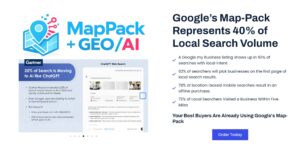
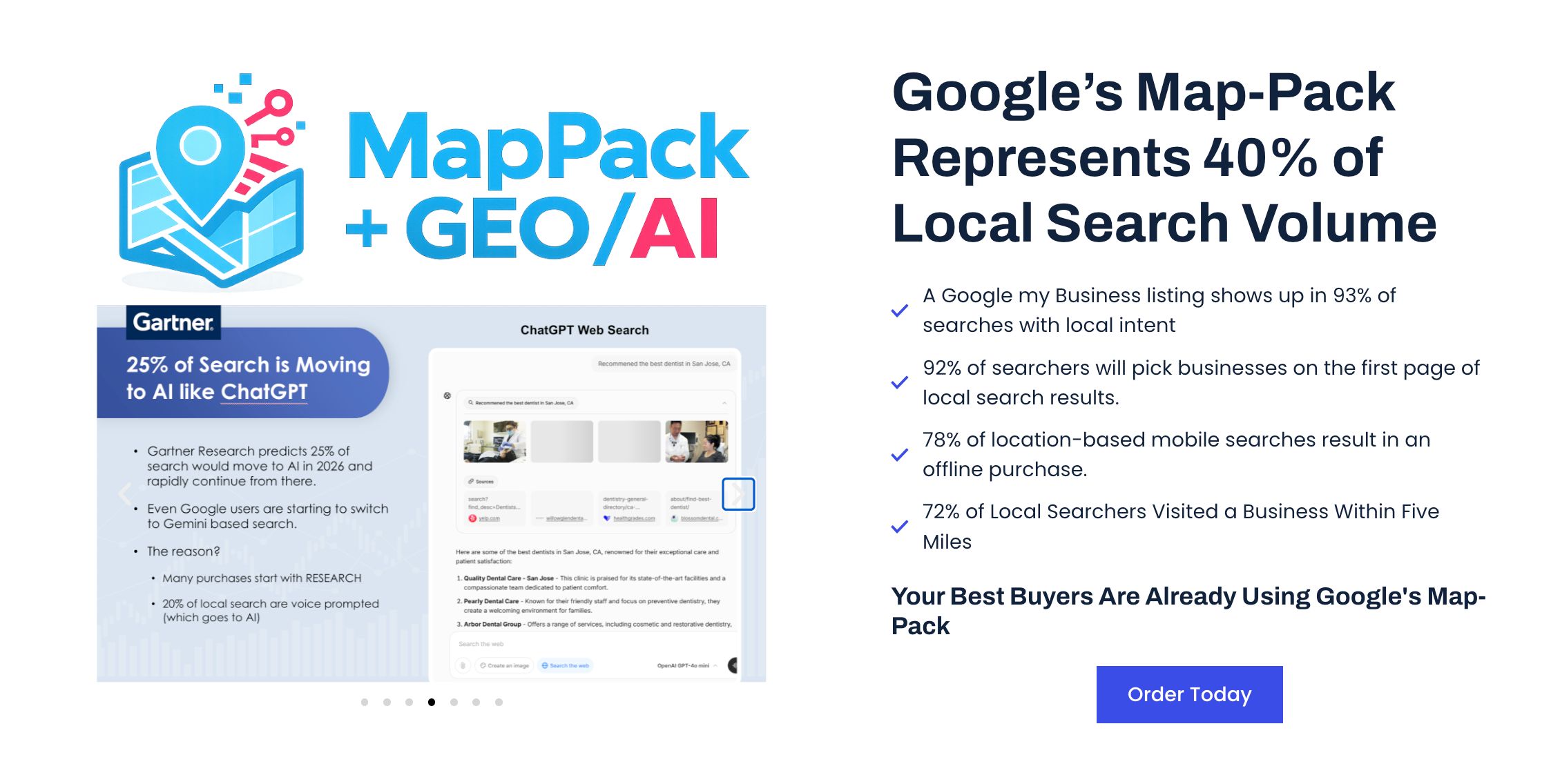
- The Map-Pack still commands roughly 40% of local search volume, but AI-driven discovery is rapidly claiming the rest — smart local businesses need both engines firing simultaneously.
- Building visibility in both Google’s Map-Pack and AI search engines requires a specific, structured Foundation — and most SMBs are skipping it entirely without realizing the cost.
- Later in this article, we break down the most common mistake local businesses make that buries them in AI search results — and it’s simpler to fix than most people think.
Local business discovery changed the moment AI search went mainstream — and most business owners haven’t adjusted their strategy yet. EthosM2’s Local MapPack + GEO service was built specifically for this moment, helping SMBs get found in both Google’s Map-Pack and every major AI search engine simultaneously.
This isn’t a future trend to watch. It’s a present-tense shift in how your customers find you, choose you, and walk through your door.
Key Takeaways: What AI Search Means for Your Local Business Right Now
Before we get into the mechanics, here’s the bottom line: AI for local business discovery is not replacing local SEO — it’s layering on top of it. The businesses that win are the ones building visibility in both systems at once, not choosing between them.
45% of Consumers Are Already Using AI to Find Local Businesses
Nearly 60% of consumers say they’ve used AI to help them shop, according to Salesforce research — and the adoption curve is still climbing. The number of consumers who started their shopping searches with AI chat assistants jumped 38% between May and August of 2024 alone. That’s not gradual drift. That’s a category shift. For local businesses, leveraging AI tools like the Google Map Pack and ChatGPT Visibility System can be crucial to remain competitive in this evolving landscape.
What’s driving it? Speed and personalization. As Salesforce’s research found, consumers say AI is giving them the best personalized recommendations — and they trust those recommendations. In fact, 87% of U.S. shoppers say they trust AI recommendations, according to the same Salesforce data. That level of trust, built that quickly, is unprecedented in consumer technology.
57% of AI Users Search While Standing Inside a Store
Here’s the detail that should stop you mid-scroll: Salesforce research shows that more than half of AI users — 57% — are conducting AI searches while physically inside a store. They’re not sitting at home deliberating. They’re standing in front of a competitor’s shelf, asking AI whether there’s a better option nearby.
That means AI for local business discovery isn’t just a top-of-funnel awareness play. It’s influencing decisions at the exact moment of purchase. If your business shows up in that AI response, you capture the customer. If it doesn’t, the customer standing five blocks away never knows you exist.
AI Search Is Collapsing the Traditional Customer Journey
The old marketing funnel — awareness, consideration, intent, purchase — assumed time between each stage. AI is compressing all of it. Nearly 77% of people say AI helps them make faster decisions, according to Salesforce. That means influence has to happen earlier, faster, and with far less friction than traditional local marketing allows.
Brands that relied on review volume, website authority, or word-of-mouth alone are finding those signals insufficient when the AI engine is curating the answer before the customer even sees their site. The discovery layer is shifting upstream — and businesses need to meet customers there.
Why AI Recommendations Have Earned Consumer Trust Faster Than Expected
Research from Longoni and Cian, published in the Journal of Marketing Research, offers a useful nuance here: people tend to trust AI more for practical, functional purchases but still prefer human input for emotional or hedonic decisions. For most local service businesses — HVAC, dental, auto repair, urgent care, home services — that’s good news. These are practical, needs-driven categories where AI recommendations land with high credibility.
The implication is direct: if your business is structured and described in a way AI engines can parse, cite, and trust, you’re not competing for a ranking — you’re competing for a recommendation. That’s a fundamentally different optimization target than traditional SEO, and it requires a different approach. For insights on how AI is transforming small business strategies, check out this article on AI small business trends.
Frame the Visibility Problem
Most local businesses are optimizing for yesterday’s search engine. They’re chasing Google rankings, managing their Yelp page, and collecting reviews — and those things still matter. But they’re not enough anymore. The visibility problem isn’t that local businesses are invisible; it’s that they’re invisible to the engines their customers are now actually using.
Gartner projects that roughly 25% of traditional search volume will shift to AI engines by 2026. That’s not a slow erosion — that’s a quarter of your potential discovery traffic migrating to a system most local businesses haven’t touched. The businesses that move now build a structural advantage that compounds. The ones that wait inherit a catch-up problem.
How Local Search Behavior Shifted From Blue Links to One AI Answer
Google’s traditional search results gave users ten organic results, a Map-Pack of three to seven listings, and a set of ads. Competitive, yes — but at least there were multiple slots. AI search engines collapsed that architecture into a single response. When someone asks ChatGPT or Perplexity “best pediatric dentist near me,” they get one answer. Maybe two. Not a list of ten. For businesses looking to navigate this change, understanding the Google Ads auction strategy can be crucial.
That compression changes the economics of local visibility entirely. The difference between being the recommended business and the second-best option is no longer a difference in click-through rate — it’s the difference between existing and not existing in that customer’s decision process. This shift is evident in new systems like the Google Map Pack and ChatGPT visibility system for local businesses.
What Slipping Out of AI’s Single Recommendation Actually Costs You
Consider the math for a local service business averaging $250 per transaction. According to Google’s Think with Google research, approximately 78% of location-based mobile searches result in an offline purchase, and 72% of local searchers visit a business within 5 miles. If AI-driven discovery is routing even twenty customers per month to a competitor instead of you, that’s a quantifiable revenue loss — not a hypothetical SEO concern.
The Map-Pack Still Captures ~40% of Local Search Volume — And AI Is Eating the Rest
It’s important not to overcorrect here. Google’s Map-Pack remains a dominant force — it captures approximately 40% of local search volume, and Google Business Profiles appear in roughly 93% of local-intent searches. Abandoning Map-Pack optimization for AI search would be a mistake. The winning strategy runs both simultaneously.
That’s precisely why the most effective approach to local visibility treats Google Map-Pack domination and Generative Engine Optimization (GEO) as two engines under one Foundation — not two separate products or competing priorities. You need both firing at the same time, feeding each other’s authority signals, to capture the full spectrum of how your customers search today.
Foundation — the F in FOCAS
The FOCAS Growth Framework — Foundation, Optimization, Conversion, Authority, Scale — is built on a single operating principle: you cannot optimize what isn’t visible, and you cannot convert traffic you never receive. The Foundation phase isn’t a starting point you graduate from. It’s the infrastructure everything else runs on.
Most agencies skip Foundation entirely. They sell tools, audits, or campaigns — and hand you a report. What they don’t deliver is the deployed infrastructure: the optimized Google Business Profile, the structured schema markup, the llm.txt file that tells AI engines what your business does and where, the “Near Me” signal architecture, the map-specific landing pages. Without those pieces in place, every dollar spent on Optimization, Conversion, and Authority is working against friction that shouldn’t exist.
Foundation is not a phase you complete and move past. It’s the operating layer that determines whether every other growth investment pays off or leaks. Visibility precedes everything — optimization, conversion, authority, and scale all depend on it.
This is especially true in a dual-engine search environment. Google’s Map-Pack has its own ranking logic — proximity, relevance, prominence — and AI engines have theirs: structured data, citation consistency, content that answers questions directly and authoritatively. Building a Foundation that serves both systems simultaneously requires deliberate architecture, not just a GBP refresh and a few blog posts.
Why Visibility Is the Precondition for Optimization, Conversion, Authority, and Scale
Think of it this way: conversion rate optimization means nothing if the customers who would convert never find you. Authority campaigns built on publisher distribution fall flat if the underlying business data AI engines pull from is inconsistent or incomplete. Scale — whether through paid media, referral systems, or expanded locations — accelerates whatever foundation is already in place. Build on sand, and scale just exposes the problem faster.
What “Building the Foundation” Looks Like in a World With Two Search Engines
Building the Foundation in a dual-engine search environment means constructing two parallel visibility systems that reinforce each other. Your Google Business Profile feeds Map-Pack rankings. Your structured schema markup, citation consistency, and llm.txt file feed AI engine recommendations. When both are built correctly, they create a compounding signal — Google sees an authoritative local business, and AI engines see a trustworthy, well-described entity they can confidently recommend.
In practice, this means your business name, address, phone number, hours, and service descriptions need to be identical and structured across every platform AI engines index. It means your website needs to answer the exact questions your customers are typing into ChatGPT and Perplexity. And it means your Google Business Profile needs to be treated as a living asset — not a one-time setup that collects dust.
How EthosM2 Builds the Foundation (Done-for-You)
Most agencies will sell you an audit and a dashboard. EthosM2 delivers the strategy, the blueprint, and the deployed execution — end to end, white-glove, done for you. The difference isn’t philosophical. It’s operational. While most SMB owners are running their business, we’re building the infrastructure that makes sure the right customers can find it — in Google’s Map-Pack and in every major AI search engine simultaneously.
Google Map-Pack Domination: GBP Optimization, “Near Me” Signals, and Local Landing Pages
Map-Pack performance is driven by three core signals: relevance, proximity, and prominence. We build all three deliberately. That means a fully optimized Google Business Profile with accurate categories, keyword-rich descriptions, structured service listings, and a consistent posting cadence. It means engineering “Near Me” signals across your web presence so Google’s local algorithm understands exactly where you operate and who you serve. And it means building map-specific landing pages — not generic location pages, but targeted, structured pages designed to rank for the local queries your customers are actually searching.
According to Think with Google, Google Business Profiles appear in approximately 93% of local-intent searches. That presence only translates to calls and visits if the profile is built correctly — and most aren’t. Incomplete categories, missing service areas, unverified attributes, and stale posts are leaving Map-Pack rankings on the table every single day. For more insights on how AI is impacting local businesses, check out this discussion on small businesses getting replaced by AI.
GEO — Generative Engine Optimization: Schema, llm.txt, and AI-Engine Content Structuring
Generative Engine Optimization (GEO) is the discipline of structuring your business’s digital presence so that AI engines — ChatGPT, Gemini, CoPilot, Grok, Perplexity — can find, parse, trust, and cite your business when a relevant local query comes in. This is categorically different from traditional SEO, which optimizes for crawlers ranking pages. GEO optimizes for language models selecting entities.
The technical components include schema markup that tells AI engines exactly what your business does, where it operates, and what problems it solves. It includes an llm.txt file — a structured document that gives AI systems a clean, authoritative summary of your business, analogous to what robots.txt does for search crawlers. And it includes content architecture that answers common local questions directly and authoritatively, because AI engines surface businesses that answer questions — not just businesses that rank for keywords.
What to Expect: Verifiable Increases in Calls and Leads Within 90 Days
The Foundation phase is priced at $850–$2,350/month for full service, with a launch offer of $1,495/month for one location, up to seven keywords. That’s not a retainer for reports and recommendations. It’s deployed execution — GBP optimization, schema markup, llm.txt implementation, “Near Me” signal architecture, map-specific landing pages, ongoing posting and engagement, and GEO structuring for AI engines. The benchmark is straightforward: verifiable increases in calls and leads in less than 90 days.
Democratizing Enterprise-Level Technology for Small Businesses and Nonprofits
Large enterprises have had access to structured local SEO, schema deployment, and AI-readiness infrastructure for years — built by in-house teams and six-figure agency retainers. The independent HVAC company, the two-location dental practice, the nonprofit serving a specific zip code — they’ve been competing blind.
That’s the gap EthosM2 was built to close. As one EthosM2 leader put it: “Our mission is to bring enterprise-level systems to SMBs.” — VP of Customer Relations, EthosM2. The technology exists. The frameworks exist. The only thing that was missing was a done-for-you delivery model that made it accessible without requiring an in-house marketing team to operate it.
This is what “democratizing enterprise-level technology for small businesses and nonprofits” looks like in practice — not a slogan, but a specific operational commitment. Every SMB EthosM2 works with gets the same Foundation architecture that enterprise brands deploy, delivered without the enterprise overhead.
- Google Business Profile optimization — categories, descriptions, attributes, service areas, and Q&A structured for Map-Pack ranking signals
- “Near Me” signal architecture — on-site and off-site signals that tell Google’s local algorithm exactly where you operate
- Map-specific landing pages — structured, targeted pages built to rank for high-intent local queries
- Schema markup deployment — structured data that makes your business readable and trustworthy to AI engines
- llm.txt implementation — a clean, authoritative business summary that AI language models can cite with confidence
- AI-engine content structuring — question-and-answer architecture that positions your business as the authoritative local source
- Ongoing posting and engagement — consistent GBP activity that signals an active, credible business to both Google and AI systems
Implementation Steps for the Reader (DIY Path, With Honesty About Where It Stalls)
If you want to start building your Foundation before engaging a service, here’s where to focus. These steps will move the needle — but understand upfront that the technical components, particularly schema deployment and llm.txt structuring, stall most businesses without dedicated execution support. The strategy is straightforward. The implementation is where the gap opens.
Work through these in order. Each step builds on the last, and skipping ahead — jumping to content creation before your GBP is solid, for example — produces compounding gaps rather than compounding gains.
1. Audit and Fully Claim Your Google Business Profile
Start with your Google Business Profile. Claim it if it’s unclaimed, verify it if it’s unverified, and then audit every field as if a customer’s first impression depends on it — because it does. Business name, address, and phone number must match exactly what appears on your website and every directory where your business is listed. Any inconsistency creates a trust signal problem for both Google and AI engines.
Beyond the basics: select primary and secondary categories with precision. Add every service you offer with individual descriptions. Upload fresh, geotagged photos. Turn on messaging. Answer every question in the Q&A section before a stranger does it for you. Approximately 92% of consumers pick a first-page local result — your GBP is often the deciding factor in whether you make that page.
2. Answer the Questions Your Customers Are Already Asking AI
Open ChatGPT, Gemini, or Perplexity and type the questions your customers ask most often — “best [your service] near [your city],” “how much does [your service] cost in [your city],” “[your service] open on weekends near me.” Look at what comes back. That output tells you exactly what content AI engines are drawing from and what your business needs to produce to become part of that answer set.
Build dedicated FAQ pages, service pages, and location pages that answer these questions directly, in plain language, with your business’s specific details. AI engines don’t reward keyword density — they reward clarity, specificity, and authority. A page that directly answers “how much does a roof inspection cost in Richmond, VA” with accurate, locally-specific information will outperform a generic service page every time.
Repeat this process quarterly. AI search behavior evolves — the questions consumers are asking AI in Q1 of one year may shift materially by Q3. Businesses that treat their content as a living asset, not a one-time build, maintain their AI visibility advantage over time.
3. Structure Your Content So AI Engines Can Read and Trust It
Schema markup is non-negotiable for AI-engine visibility. At minimum, implement LocalBusiness schema on your homepage and location pages — this tells AI engines your business name, address, phone, hours, and service area in a machine-readable format they can parse and cite. Add FAQPage schema to your FAQ content. Add Service schema to individual service pages. If you’re running this manually, Google’s Rich Results Test will validate your implementation. For more insights, check out the Google Map Pack and ChatGPT visibility system for local businesses.
The Most Common Mistake Local Businesses Make — and Why It Buries Them
The single most common mistake is treating AI search and local SEO as separate, optional strategies rather than a unified Foundation. Business owners either focus entirely on Google rankings and ignore AI engines, or they get excited about AI visibility and neglect their GBP and Map-Pack presence. Both approaches leave significant discovery traffic on the table. The Map-Pack and AI engines are not competing channels — they’re two surfaces of the same local visibility system. Build them together or rebuild twice.
Proof / Ecosystem Handoff
Visibility is the beginning, not the destination. Once your Foundation is in place — your GBP optimized, your schema deployed, your llm.txt structured, your Map-Pack and AI-engine signals firing — the next question becomes: what happens when those customers actually find you? That’s where the FOCAS Growth Framework hands off from Foundation to the systems that capture, route, and convert the traffic you’ve built.
Where Map-Pack and GEO Hand Off to Lead Capture and AI Agents
When a customer finds your business through Google’s Map-Pack or an AI engine recommendation and clicks through, that lead needs to be captured and routed immediately. EM2-BOS handles that handoff — using AI Agents to capture inbound leads, qualify intent, and route them to the right follow-up sequence before the customer loses momentum. The average business loses a significant percentage of inbound leads simply because no one responds within the first five minutes. AI Agents close that gap entirely.
INTENTIVE™ sits alongside that process, optimizing specifically for high-intent search behavior — the customers who aren’t browsing, they’re ready to buy. These aren’t generic leads. They’re people who asked an AI engine for a recommendation and clicked yours. Their intent is already qualified. The system’s job is to make sure nothing drops them before conversion.
How the Full FOCAS Framework Moves You From Visible to Scalable
The FOCAS Growth Framework — Foundation, Optimization, Conversion, Authority, Scale — is a sequential operating system, not a menu of optional services. Foundation gets you found. Optimization tightens what’s working. Conversion turns traffic into revenue. Authority, built through tools like Catalyst Pro’s 400+ publisher distribution network, establishes your business as the credible, dominant voice in your local market. Scale accelerates everything that’s already performing.
FOCAS AMS™ automates the nurture layer between Conversion and Authority — so leads who don’t convert immediately aren’t lost, they’re sequenced. For an SMB running their business full-time, this entire system operates in the background. The Foundation phase makes it possible. Every subsequent phase makes it more valuable. Skip Foundation, and every other investment in the framework underperforms from day one.
Frequently Asked Questions
The questions below come up consistently when local business owners start thinking seriously about AI for local business discovery. The answers are direct — no jargon, no hedging.
How Is AI Search Different From Google Search for Local Businesses?
Google Search returns a list of results — Map-Pack listings, organic pages, ads — and the customer chooses from multiple options. AI search engines like ChatGPT, Gemini, and Perplexity return a synthesized response, often naming one or two businesses directly as the recommendation. The customer doesn’t compare a list; they receive an answer.
For local businesses, this means the competitive dynamic has fundamentally changed. In Google Search, being in the top three Map-Pack results still gives you visibility. In AI search, if you’re not the recommended business, you may not appear at all. The optimization targets are different, the content requirements are different, and the infrastructure needed to compete is different — which is why building for both simultaneously is the only complete strategy.
Does My Business Need to Be on ChatGPT, Gemini, and Perplexity Separately?
No — and this is one of the most important things to understand about Generative Engine Optimization. You don’t submit your business to AI engines the way you’d claim a Yelp profile. AI engines pull data from the web, from structured data sources, from directories, and from indexed content. When your Foundation is built correctly — consistent NAP data, deployed schema markup, llm.txt, authoritative local content — all major AI engines can find, parse, and cite your business from that single, unified Foundation.
That said, each AI engine has its own data sourcing tendencies. Perplexity indexes heavily from live web content. ChatGPT draws from its training data and, in browsing mode, from current web sources. Gemini integrates tightly with Google’s own data ecosystem, which means a strong GBP and Map-Pack presence directly feeds Gemini’s local recommendations. A properly built Foundation serves all of them without requiring separate submissions to each platform.
What Is Generative Engine Optimization (GEO) and How Is It Different From SEO?
Traditional SEO optimizes your web presence so that Google’s crawlers rank your pages highly in search results. The goal is a high ranking on a results page. Generative Engine Optimization (GEO) optimizes your business’s digital presence so that AI language models recognize your business as the authoritative, trustworthy answer to a local query — and cite you in their generated response. The goal is a recommendation, not a ranking.
The technical requirements differ significantly. SEO prioritizes keyword placement, backlink authority, and page speed. GEO prioritizes structured data (schema markup), entity clarity, citation consistency across the web, direct question-and-answer content architecture, and signals like llm.txt that help AI engines understand your business at the entity level. Both disciplines matter — and the most effective local visibility strategy integrates them into a unified Foundation rather than treating them as competing approaches.
How Long Before AI Search Optimization Produces Real Results?
The honest answer depends on your starting point, your category, your geography, and how competitive your local market is. That said, EthosM2’s benchmark for the Foundation phase is a verifiable increase in calls and leads in less than 90 days. For businesses with a completely unclaimed or poorly optimized GBP, Map-Pack improvements can appear within 30–45 days of proper optimization. AI-engine visibility improvements follow the indexing and update cycles of each platform, which can run four to twelve weeks.
What accelerates results is consistency and completeness. A fully deployed Foundation — GBP optimization, schema markup, llm.txt, local landing pages, and ongoing posting — compounds faster than a partial implementation. Businesses that treat Foundation as a one-time task and stop posting, updating, or building citations will see early gains plateau. The ones that maintain the system see compounding visibility gains that become increasingly difficult for competitors to close.
What Does a Done-for-You Local SEO and GEO Service Actually Include?
EthosM2’s Local MapPack + GEO service is the Foundation phase of the FOCAS Growth Framework — and “done-for-you” means exactly that. There are no dashboards handed off to you to manage, no audits delivered as PDFs, no recommendations left for your team to implement. The execution is ours.
Specifically, the service includes full Google Business Profile optimization, “Near Me” signal architecture, map-specific landing page development, schema markup deployment, llm.txt implementation, AI-engine content structuring, ongoing GBP posting and engagement management, and citation consistency management across the directories AI engines index. Service is available in DC, MD, VA, and FL — with delivery extending beyond those markets. Pricing runs $850–$2,350/month for full service, with a launch offer of $1,495/month for one location, up to seven keywords. The benchmark commitment is simple: verifiable increases in calls and leads in under 90 days. For more information on enhancing local business visibility, check out our Google Map Pack and ChatGPT visibility system.
Conclusion + CTA
AI for local business discovery isn’t a coming disruption — it’s a present-tense operational reality that’s already routing customers to businesses with the right Foundation and away from those without it. The Map-Pack still commands roughly 40% of local search volume. AI engines are rapidly claiming the rest. The businesses that build visibility in both systems simultaneously, right now, are building a structural advantage that will compound for years. The ones that wait are inheriting a catch-up problem that gets more expensive every quarter.
The Foundation is not the beginning of your marketing strategy. It’s the precondition for every other part of it to work. Optimization, conversion, authority, scale — none of those phases pay off if the customers who need you can’t find you in the engines they’re actually using to search.
The good news is that this problem is solvable — completely, systematically, and without requiring you to become a local SEO or GEO expert yourself. The infrastructure exists. The framework exists. The only variable is whether you build it now or later.
If you’re ready to get found in both Google’s Map-Pack and every major AI search engine — without doing it yourself — EthosM2’s Local MapPack + GEO service delivers the full Foundation, end to end, so you can run your business while we build the visibility system it deserves.