The issue for most small business owners isn’t productivity. It’s their systems — and no app can solve that.
This article is for you if you’ve ever felt like you’re managing software instead of managing growth. EM2-BOS™ was built specifically for this gap: the space between running a business and actually building one.
Summary: Why Small Businesses Need an Operating System Instead of Another Tool
- The typical small business operates 10+ disparate tools at the same time — and most of them overlap, conflict, or go unused.
- Operational gaps cost small businesses up to $200,000 per year in missed calls, lost leads, and no-shows.
- 80% of leads are lost within the first 5 minutes of no response — a problem no single app solves on its own.
- A true business operating system combines strategy, automation, and communication into one deployable infrastructure.
- The FOCAS Growth Framework™ starts at Foundation — because no optimization, conversion, or scale works without the right base in place.
There’s a trend that appears in nearly every small business hitting a growth ceiling. The owner is smart. The team is competent. The offer is sound. But somewhere between the first customer inquiry and the closed sale, things fall apart — quietly, repeatedly, and expensively.
It’s Not About the Tools — It’s About the System
When something goes wrong in a business, the knee-jerk reaction is often to find a tool that will fix it. Are leads getting lost? Bring in a CRM. Appointments being forgotten? Bring in a scheduler. Reviews not getting responses? Bring in a reputation management app. But before you know it, you’re juggling a dozen platforms that don’t communicate with each other, each one needing a separate login, separate training, and separate monthly fees.
That’s not a tech stack. That’s a ticking time bomb. It’s also one of the primary reasons why many small businesses hit a wall before they can truly take off.
Small to Medium Businesses Often Operate Over 10 Unconnected Tools at Once
Productiv’s SaaS management research suggests that businesses of all sizes average over 100 SaaS applications at the enterprise level. However, small to medium businesses, despite having significantly fewer resources, often operate between 10 to 15 tools in an attempt to mimic the functionality of an integrated system. The issue isn’t a lack of software. It’s a lack of structure.
Why More Software Isn’t the Solution
Every time you add a new tool, you’re introducing a new potential point of failure. You’re adding a new login to remember, a new workflow to manage, and a new learning curve for your team. Plus, these tools aren’t designed to work in harmony, so you end up manually transferring data, devising workarounds, and wasting hours on tasks that an all-in-one system could take care of in an instant.
The snowball effect is harsh. What began as a simple scheduling app and CRM morphs into a labyrinth of automations, webhooks, and third-party integrations that only the individual who created them can comprehend. When that person departs or becomes overwhelmed, the entire system crumbles.
The True Price: As Much as $200K/Year Lost to Operational Shortcomings
This isn’t theoretical. The operational shortcomings that arise from disjointed tools carry a direct dollar cost. Missed appointments alone can cost some service businesses as much as $200,000 per year when you consider lost appointments, idle staff time, and the revenue that’s never rebooked. That figure doesn’t even include the leads that went cold, the after-hours calls that were never returned, or the reviews that went unanswered for weeks.
Small businesses miss roughly 62% of calls that come in after hours. If a lead doesn’t get a response within the first five minutes, there’s an 80% chance it will be lost. These aren’t outliers; they’re what typically happens when a business doesn’t have a unified operating system.
The table below shows where revenue is most often lost — and what it usually costs a service-based small business that uses disconnected tools:
|
Operational Gap |
Root Cause |
Estimated Annual Revenue Impact |
|---|---|---|
|
Missed after-hours calls |
No 24/7 response system |
$15,000–$60,000+ |
|
Slow lead response |
Manual follow-up, no automation |
$20,000–$80,000+ |
|
Appointment no-shows |
No confirmation or reminder workflow |
Up to $200,000 |
|
Unanswered reviews |
No reputation management process |
Indirect — damages conversion rate |
|
Untracked lead pipeline |
CRM not integrated with communications |
$10,000–$50,000+ |
|
Estimates based on industry averages for service-based SMBs. Actual figures vary by industry, volume, and market. |
The lack of a system doesn’t just create inconvenience. It can be a matter of survival for a business trying to grow beyond the owner’s personal bandwidth.
Identifying the Issue
In order to solve the correct issue, you must first correctly identify the problem. The main issue for most SMBs is not a lack of ambition or resources. The problem is that the business relies on people rather than systems. People are inconsistent, can only do so much in a given amount of time, and cannot be scaled up.
Your Business Relies on People, Not Systems
If the only reason a potential customer is contacted is because you personally remembered to call them, your business has a single point of failure: you. If appointments only get confirmed when your front desk remembers to send a text, you’re one busy afternoon away from a missed appointment. A business that relies on systems runs the same way whether you’re in the office or on vacation. A business that relies on people doesn’t run at all the moment attention shifts.
A Massive 62% of After-Hours Calls Are Unanswered — and That’s Just the Start of the Problem
One of the most glaring examples of this issue is the problem of after-hours calls. If a potential customer rings your business at 8 PM and there’s no answer, they’re not going to wait until the next day — they’ll just call your competitor. EM2-BOS AI Agents answer in less than a second, 24/7, with no waiting music and no risk of being sent to voicemail. Over 14.7 million calls have been dealt with in this way across the platform. That’s not a feature. That’s an essential part of the infrastructure.
Without a Response System, 80% of Leads Are Lost in the First 5 Minutes
Speed-to-lead is one of the most well-known factors in sales. Harvard Business Review discovered that businesses that contacted leads within an hour were almost 7 times more likely to have meaningful discussions than those that waited even 60 minutes. For SMBs that rely on manual follow-up, consistently hitting that window is nearly impossible. The leads don’t vanish — they just go to whoever responded first. Many small businesses continue to struggle with outdated systems, making it even harder to capitalize on speed-to-lead.
- It’s 2 PM on a Tuesday and a potential customer submits a form
- Your team is busy juggling three other tasks simultaneously
- By the time 4:30 PM rolls around, a follow-up email is finally sent
- Unfortunately, by 2:07 PM, the potential customer had already scheduled with a competitor
This isn’t some made-up scenario. This happens countless times each month in businesses that don’t have an automated response for leads. The worst part is, the business owner often has no idea it’s happening because there’s no system in place to track where leads are falling through the cracks.
The solution is not to employ a quicker salesperson. Instead, it’s to implement a system that reacts immediately, automatically qualifies, and only directs to a human when a human is really required.
Using Multiple Tools Leads to Confusion, Not Understanding
The paradox of using many tools is that each tool was bought to address a specific issue. However, when those tools do not exchange data, do not activate each other, and require separate management, the overhead they produce often surpasses the issue they addressed. You end up with five different dashboards showing you five different things, none of which provide you with a clear understanding of what your business really needs to do next. This is why many businesses feel like their CRM feels like another tool they’re paying for but not using.
The Guiding Philosophy
A business operating system isn’t a piece of software. It’s the structure that allows every aspect of your business — strategy, communication, automation, follow-up, reporting — to function as one cohesive unit. The software is merely the delivery method.
The FOCAS Growth Framework™: It All Begins With a Solid Foundation
The FOCAS AMS™ framework is composed of five stages: Foundation, Optimization, Conversion, Authority, and Scale. Every business we partner with begins at the Foundation stage — not because it’s the most thrilling, but because nothing else will stick without it. Foundation signifies that your CRM is set up correctly, your automations are linked to actual workflows, your communications are coordinated, and your team is working from a single source of truth. If you build on sand, everything above it is temporary. If you build on a Foundation, everything above it will compound.
What a Genuine Business Operating System Brings Together
A genuine operating system integrates every function of your business that is critical to revenue into one unified infrastructure. This implies that your CRM, your communication channels, your appointment scheduling, your follow-up sequences, your reputation management, and your reporting all reside in the same environment — sharing data, activating each other, and providing you with a single clear view of your business’s current status.
Understanding the Difference Between System-Dependent and People-Dependent
Consider this: if you were to go on a two-week vacation tomorrow and had no access to your phone, what would fall apart? If your answer is “nearly everything,” then your business is people-dependent. This isn’t a criticism — it’s where most SMBs begin. But it’s not where they end up if they’re successful.
Businesses that rely on systems have processes that are documented, follow-ups that are automated, and workflows for communication that run no matter who is in the office. Your leads get responses. Your appointments get confirmations. Your reviews get replies. Not because someone remembered to do it, but because the system does it automatically, every time, without fail.
A Single Platform, A Single Language, A Single Direction
One of the most overlooked advantages of a unified operating system is the shared language it establishes within your company. When every department — be it sales, operations, customer service — is using the same platform, you cease having discussions about which figure is correct and begin having discussions about what the next steps should be. Transparency at the platform level leads to transparency at the execution level. That’s how businesses grow without disorder. To understand why many small businesses are still lagging behind, read about why 73% of small businesses are still running their operations like it’s 2015.
The EM2-BOS Approach
Unlike most agencies that simply sell you a subscription and send you a tutorial video, EM2-BOS™ operates on a completely different principle. We believe that small business owners don’t need more tools to manage. Instead, they need a fully implemented, strategy-backed system that is designed to hit a real revenue target. The difference between purchasing software and having a business operating system built for you is like the difference between owning a gym membership and having a personal trainer, a nutritionist, and a recovery coach working together to achieve a single goal.
When you hear the phrase “Making enterprise-level technology available to small businesses and nonprofits,” this is what it really means. It’s not about offering a cheaper tool. It’s about providing a full operational infrastructure that was once only available to businesses that could afford to have their own tech teams and IT budgets in the six figures.
Strategy First: Understanding Your Revenue Structure Before Using a Tool
The EM2-BOS™ engagement doesn’t start with setting up software. It starts with understanding your revenue structure — where your leads come from, where they leave, what your most valuable customer looks like, and what the quickest way to your next revenue milestone really is. That strategic layer is what separates a business operating system from a CRM setup service. Tools without strategy are just costly guesswork.
Most SMBs have never had this conversation with a technology partner because most technology partners aren’t asking strategic questions. They’re asking which features you want turned on. We ask what your business needs to generate $X in the next 90 days — and then we build backward from that answer. Learn more about the real reason your CRM feels like another tool and how to make it work for you.
Planning Stage: Creating a System Based on Your Business Objectives
After the plan is laid out, the planning stage turns it into a working, structured system. Each automation, each pipeline stage, each communication workflow is created to show how your business truly functions — not a one-size-fits-all template. This is where most tool-based methods fall short. A template assumes your business operates like all the others. A plan is made specifically for your business, similar to how Fortune 500 companies optimize their operations.
White-Glove Deployment: From Launch to Revenue Target
Deployment is where EM2-BOS™ most clearly distinguishes itself from all other options on the market. You don’t just launch and then try to work it out. We deploy the system, oversee performance, take care of the technical burden, and remain responsible for the revenue target set in the strategy phase. Your role is to manage your business. Our role is to ensure the system manages everything else.
This isn’t a handoff. There’s no moment where you receive a login and a user guide and get wished good luck. The white-glove model means we’re in it with you — configuring, optimizing, and refining until the system performs the way it was designed to. As the VP of Customer Relations at EM2-BOS™ puts it: “Our mission is to bring enterprise-level systems to SMBs.” That mission only means something if the system actually gets deployed and actually works.
How to Get Started
If you’re ready to make the transition from a stack of tools to a single operating system, you might be surprised to find that the journey is easier than you think. The hard part is in the details of building the system — not in deciding to start. Here’s how you can tackle it.
Step 1: Check All the Tools You’re Currently Paying For
Go through your bank statement and your email inbox to make a list of every software subscription that your business is currently running. Don’t try to filter or justify anything. Just list them all. Most business owners are genuinely surprised by the number of subscriptions they have — and they’re even more surprised by how many of them have overlapping functions or are barely used.
For each tool on that list, you need to ask yourself three questions: What issue was this purchased to address? Is it addressing that issue right now? Is it directly linked to any other tool in the stack? If the answer to the second or third question is no, that tool is costing you more than it’s contributing.
What you should be seeking is not merely a reduction in expenditure — it’s a blueprint of your operational deficiencies. Each tool that is only somewhat addressing an issue, or addressing it independently of everything else, is an indication that the underlying system architecture is flawed. The objective of this audit isn’t to reduce expenses. It’s to gain a clear understanding of what you’re actually dealing with before you make a decision on what to replace it with.
- List every active software subscription — including annual ones you might have forgotten about
- Note what business function each tool was meant to handle
- Identify which tools share data with other tools and which operate in complete isolation
- Flag any tool your team uses inconsistently or has stopped using altogether
- Calculate the total monthly cost of your current stack, including time spent managing each platform
Step 2: Identify the Three Biggest Gaps Costing You Revenue
After the audit, the gaps become visible. For most service-based SMBs, the top three are lead response time, appointment confirmation and follow-up, and post-sale communication. These aren’t glamorous problems — but they’re the ones quietly draining revenue every single week. Fixing all three inside a unified operating system can recover tens of thousands of dollars annually that are currently being left on the table through pure operational friction.
Step 3: Swap Out the Stack for a Unified Operating System
We’re not talking about changing CRMs here. What we’re talking about is replacing a mishmash of disconnected tools with one unified infrastructure that can manage the entire customer journey — from initial contact to sealing the deal to long-term customer retention. The swap isn’t purely technical. It also requires a strategic layer to map your real-world workflows, a configuration layer to tailor the system to suit them, and a deployment layer to bring the whole thing online without causing a hiccup in your existing operations.
If executed properly, the shift from a tool stack to an operating system doesn’t add more work – it reduces it. Automated processes take the place of manual tasks. A consolidated report takes the place of switching between dashboards. A single communication inbox takes the place of five separate message threads. The overhead decreases. The output remains the same. And for the first time, your business operates the same way on a slow Tuesday as it does on your busiest Friday.
The Most Common Mistake: Mixing Systems Instead of Committing to One
The biggest implementation failure we see isn’t choosing the wrong system. It’s choosing a system and then supplementing it with the old tools because change feels uncomfortable. The moment you start running two CRMs simultaneously, or keeping a manual spreadsheet alongside an automated pipeline, you’ve recreated the exact fragmentation you were trying to escape. A business operating system only delivers its full value when it’s the single source of truth — not one of several competing sources. Commit to the system, or the system can’t commit to your results.
Real-world Evidence and the Bigger Picture
Figures speak louder than sales pitches. When a business operating system has managed over 14.7 million calls, coordinated more than 860,000 appointments, and processed in excess of 18.7 million messages, these aren’t just marketing boasts — they’re real-world evidence of operational capability. To achieve this kind of scale, the underlying infrastructure must be properly constructed and consistently implemented across a diverse range of business types, sizes, and sectors.
Those numbers aren’t being produced by Fortune 500 companies with their own IT departments. They’re coming from service-based SMBs — contractors, healthcare practices, real estate teams, law firms, salons — that have decided to stop using disconnected tools and start using a system that’s designed to perform. The results get better and better over time because the system learns and improves the longer it’s used.
14.7M+ Calls, 860K+ Appointments, 18.7M+ Messages Managed
Performance Metrics
• 14.7M+ calls managed by EM2-BOS AI Assistants — under 1 second response time, 24/7
• 860K+ appointments made through automated scheduling
• 18.7M+ messages processed through unified communication channels
• ~98% review response rate, automatically maintaining and improving online reputation
• <1 second average AI Assistant response time — no hold music, no missed opportunities
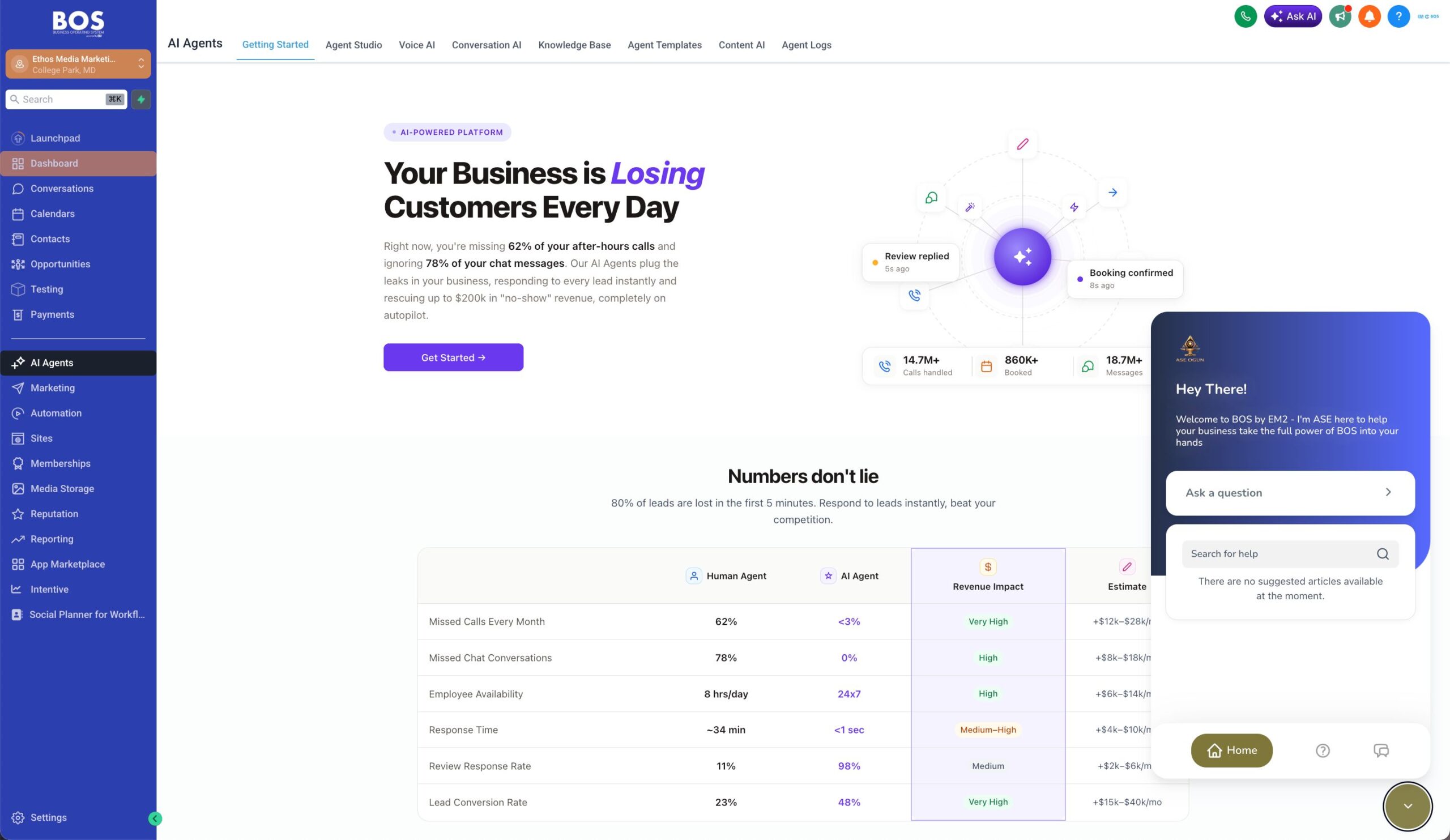
Each of these metrics represents a moment when a small business was able to stay in the game instead of losing the lead, the appointment, or the customer relationship to a slower competitor. The 62% of calls that SMBs typically miss after hours? Those calls are being managed within this platform — consistently, automatically, and without anyone on the payroll doing it manually. Discover why 73% of small businesses are still running their operations like it’s 2015.
Responding to reviews has a significant business impact. According to BrightLocal’s Local Consumer Review Survey, 88% of consumers are likely to use a business that responds to all reviews. Achieving a 98% response rate through automated, smart replies is not just a reputation management feature. It directly drives conversions. Customers are more likely to convert when they see businesses that are engaged and responsive compared to businesses that are silent.
These statistics are not just a list of features. They represent a fully operational system that works non-stop, reacts immediately, and performs consistently at a level that no human process could ever match. This is the standard of operation that every SMB should have, and it’s exactly what this platform was built to provide.
Uniting Strategy, Automation, and Growth in One Place with FOCAS AMS™
FOCAS AMS™ is the automation and content engine that powers the EM2-BOS ecosystem. It links the strategic framework — Foundation, Optimization, Conversion, Authority, Scale — with the tools that bring it to life. For many businesses, automation feels like a series of disjointed triggers. FOCAS AMS™ views automation as a growth architecture: every workflow, follow-up sequence, and content deployment is tied to a specific phase of the company’s growth journey and tied to a measurable outcome. Strategy and execution are not separate discussions. They are one and the same inside FOCAS AMS™.
How to Make Enterprise-Level Technology Accessible to Small Businesses and Nonprofits
While the concept of “Making enterprise-level technology accessible to small businesses and nonprofits” is easy to understand, it’s not so easy to implement. To implement it, you’d have to give a local HVAC company the same automated lead response infrastructure that a national home services brand uses. You’d have to give a five-person law firm the same reputation management and client communication system that a regional firm with a full marketing department uses. In other words, the size of your business would no longer determine the quality of your operational infrastructure.
The technology gap between big and small businesses has been a historical predictor of business success or failure. Large businesses respond to leads faster, follow up more consistently, manage their reputation more actively, and convert at higher rates. Not because they have better employees, but because they have better systems. This platform exists to close that gap.
Over the next ten years, the most successful businesses won’t necessarily be the ones with the most money to spend. They’ll be the ones who establish operational infrastructure early on, who rely on systems rather than people, and who take advantage of the benefits of automation and consistency over time. This isn’t a guess — it’s already happening in every market where small and medium-sized businesses have transitioned from using a stack of tools to an operating system.
Common Queries
Here are the queries that most frequently come up from business owners when they are considering if a business operating system is the right choice for them, and if now is the right time to implement it.
Understanding the Business Operating System and How It Differs from Software
A business operating system is a comprehensive framework that manages all the vital revenue-generating operations of your business as one cohesive unit. On the other hand, software is a tool that addresses one issue in one sector. A business operating system addresses the issue of coordination — ensuring that your CRM, communications, scheduling, follow-up, reporting, and reputation management all share data, activate each other, and provide you with a single clear snapshot of your business at any given time. The difference is between architecture and application. For more insights, explore the value of a business operating system.
What’s the Ideal Number of Tools for a Small Business to Use?
There’s no set number, but the more important question isn’t about the number of tools you’re using — it’s whether those tools are interconnected or standalone. A business using three closely linked tools that share data and set off each other is in a much better position than one using twelve platforms that each operate on their own. If your tools don’t communicate with each other, every additional one you add just makes things more complicated without actually increasing your capabilities. The aim is to consolidate around a single system, not to minimize just for the sake of it.
What is the implication of a White-Glove Deployment for an SMB with no Tech Team?
It implies that you don’t need a tech team. White-glove deployment implies that the strategy is designed for you, the system is set up for you, the automations are tailored to your actual workflows, and the entire infrastructure is launched without you having to comprehend how it operates technically. Your role is to be familiar with your business. Our role is to convert that familiarity into a deployed system that operates it. From intake through launch and continuous optimization, the technical burden remains on the platform side — not on yours.
How Soon Can a Small Business Expect to See Improvements After Adopting a Unified System?
Many businesses notice tangible enhancements in lead responses, confirmation of appointments, and uniformity in communication within the first month of implementation. The speed of the results is dependent on how large the operational gaps were prior to the change – businesses that had significant leaks in their lead responses or follow-up processes often see the most noticeable early improvements simply because the system is recouping revenue that was already being generated but was being lost. Longer-term compounding – growth in reputation, pipeline speed, retention rates – develops over two to three months as the system gathers performance data and is fine-tuned accordingly.
Can EM2-BOS™ be used by businesses at every stage of growth?
Indeed — and the FOCAS framework is specifically tailored to cater to a business’s current state, not its desired state. A business in the Foundation phase gets a different configuration than one in the Scale phase, because the operational priorities are genuinely different. Foundation is about getting the core infrastructure right. Scale is about ensuring that infrastructure can handle volume without breaking. The system grows with the business rather than becoming obsolete as the business matures.
However, the companies that benefit most from EM2-BOS™ in the early stages are usually service-based small and medium-sized businesses (SMBs) with a revenue of $500K to $5M that have outgrown manual processes but haven’t yet developed the internal team or infrastructure to replace them. If your business is growing faster than your systems can handle, that’s the exact point where a business operating system gives you the most bang for your buck.
What Will Happen to My Existing Tools If I Switch to EM2-BOS™?
For the most part, EM2-BOS™ will take the place of the majority of the tools you’re currently using — not because there’s anything wrong with them, but because having a unified system means you don’t need most of them on their own. The appointment scheduling tool, the standalone CRM, the separate email marketing platform, the reputation management app — all of these features are built into the operating system, so they’re linked and coordinated instead of being isolated.
The switchover is managed during the planning and implementation stage, so you won’t be abandoning your current systems before the new setup is up and running. The aim is a smooth transition with no interruption to your operations – not a disruptive overhaul. Some companies keep one or two specialist tools that perform a very specific task the operating system can’t handle, and these can usually be incorporated. But for most SMBs, the stack becomes much simpler – which is precisely the goal.
Your Company Needs a Foundation, Not Just Software
The companies that are the most challenging to operate aren’t typically the ones with the most competitive markets or the tightest profit margins. They’re the ones where the proprietor is the structure — manually maintaining a set of software, manual procedures, and unwritten rules that would crumble the moment they left. That’s not a company. That’s a job with extra expenses.
When you have a legitimate operating system, the game changes. With automated lead responses, running follow-up sequences, confirmed appointments, responded reviews, and a visible pipeline all in one place, you’re no longer the one holding everything together. Instead, you’re the strategist who determines the future of the business. This shift is what makes growth manageable rather than draining.
Are you prepared to transition from a stack of tools to a full operational structure? EM2-BOS™ provides the strategy, blueprint, and fully implemented system tailored to your specific revenue objectives. This means you can stop managing software and start constructing a business that doesn’t require you to keep it running every day. To understand the value of a business operating system, consider exploring further resources.